Updated November 13, 2026. Microsoft had not restored full service at the time of writing. We will update this article as Microsoft publishes its root cause analysis.
On Thursday afternoon, the Microsoft 365 outage took down email for organizations around the world. Within hours, Outlook was down, Teams meetings failed to schedule, Copilot went quiet, and security tooling stopped doing its job. More than a day later, Microsoft is still working to restore service.
Microsoft says at this time that is was not a cyberattack, and there is no reason to point fingers. It is a reminder of something every IT leader knows but few architectures reflect: technology is never perfect.
Key takeaways
- The Microsoft 365 outage began on November 12, 2026, and hit Outlook, Teams, SharePoint, Copilot, and Defender in at least 74 countries.
- Microsoft says servers lost capacity. As of now, they are saying it was not a traffic surge and not a cyberattack.
- Governments, courts, airlines, and AI providers were disrupted, and security controls failed along with the platform.
- Outages can happen to any provider. The real risk is giving one provider a monopoly over all of your communication.
- Wire gives organizations an independent, end-to-end encrypted communication layer under European control.
What happened in the Microsoft 365 outage?
The outage began around 1 p.m. ET on Thursday, November 12, and disrupted Outlook and other services for users in dozens of countries. At its core was Exchange Online, the email service behind Outlook for most organizations. Because so many Microsoft 365 services depend on Exchange Online, the impact quickly spread to Teams, SharePoint, Copilot, and Microsoft Defender.
What caused the Microsoft 365 outage?
At the time of this publication, Microsoft is saying that a sudden loss of capacity is to blame. They first pointed to an "elevated load" on its infrastructure. It later clarified that a number of servers became unexpectedly unavailable, leaving the rest under heavy strain. A process on the affected servers that establishes secure connections became overwhelmed, so the servers stopped processing requests.
Recovery has been slow and uneven. Servers brought back online became unresponsive again once traffic returned. Microsoft began reverting a recent network configuration change that coincided with the start of the outage, but has not confirmed a root cause. The company has promised a post-incident report once the disruption is mitigated, and Microsoft executive Charles Lamanna has ruled out a cyberattack.
Who was affected by the Outlook and Teams outage?
The scale is hard to overstate. Microsoft 365 apps have more than 430 million users, and outage reports came in from at least 74 countries. At the peak on Thursday evening, Downdetector logged nearly 140,000 reports for Outlook alone.
Public institutions were among the hardest hit:
- Government systems in Singapore and Japan were disrupted.
- Australia's intelligence and federal police agencies reported problems with email.
- Courts in the Philippines, Singapore, and North America warned that responses would be delayed.
- The Japanese government shared IT platform.
- The US House of Representatives also reported restrictions for its users.
Businesses felt it too. India's largest airline told customers its email support channel was down. Brokerages lost Teams calls with clients on quarterly results day, and at least one listed company postponed its quarterly results.
During the outage, Microsoft Defender's Safe Links may have been unable to verify URLs in Outlook and Teams. When the platform failed, the security controls built on top of it failed with it. Anthropic and OpenAI also reported that their Microsoft 365 connectors stopped working, as ITdaily reported.
And people improvised. Employees moved to personal Gmail accounts, consumer messengers, and phone calls to keep working. These workarounds are understandable, but they are invisible to IT. Nobody governs them, nothing is audited, and there is no way to know what was missed. In Wire's State of Secure Collaboration 2026 report, nearly half of organizations admitted to sharing sensitive data over insecure channels, and outages push even more communication there.
Is this the first Microsoft outage this year?
No. This is the second time in 2026 that lost server capacity has taken down several Microsoft 365 services at once, after a multi-hour incident in North America in January. For IT leaders, the pattern matters more than any single incident.
The real lesson: no single provider should own your communication
First, a word of fairness. Nobody should be blamed for this. Outages can happen to any technology provider, Wire included. Complex systems are built and run by people, and they fail in complex ways. Technology is never perfect, and no vendor can promise otherwise.
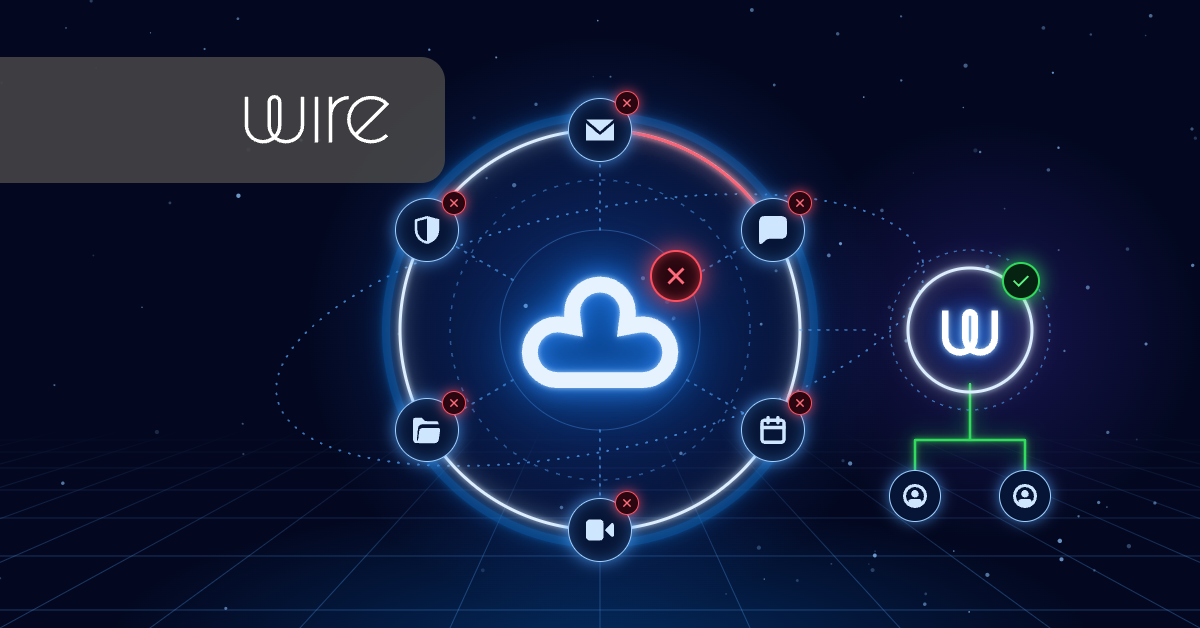
So the question is not whether a provider will fail. It is what happens to your organization when it does. Many organizations have handed a single provider a monopoly over their communication: email, chat, meetings, files, AI, and security monitoring all run in one cloud. When that cloud falters, everything falters with it, and there is no independent channel left to coordinate the response.
“Nobody should point fingers at Microsoft today. Technology is never perfect, and this can happen to any provider, including us. The real risk is putting all of your communication in one cloud with one provider. For governments and defense organizations in particular, no single service should hold a monopoly on how they communicate.”
Benjamin Schilz, Group CEO, Wire
Why governments and defense cannot rely on a single service
For most companies, an outage like this is costly and frustrating. For governments, defense organizations, and critical infrastructure operators, it is a question of operational capability. Ministries, armed forces, police, and courts must be able to communicate at any time, whether a commercial cloud fails because of a technical fault, an attack, or a geopolitical decision made elsewhere.
Some had planned for this. Japan's digital minister said agencies relying on Outlook had already secured alternative channels, including phone, chat tools, and text messages, so government operations could continue. That is the right instinct. The harder question is whether those alternatives are secure and governed, or simply whatever happens to be on employees' phones.
Regulators are already asking the same question. NIS2 requires essential and important entities to maintain business continuity and crisis management capabilities. In the financial sector, DORA explicitly addresses ICT third-party risk, including concentration on a small number of providers.
How to prepare for the next Microsoft outage
- Map your dependencies. List which critical workflows run entirely on one provider: email, meetings, files, identity, and security monitoring.
- Define a governed fallback channel. Decide in advance where teams communicate when the primary platform fails, so employees don't default to personal accounts.
- Separate the failure domains. Your fallback should not run on the same infrastructure, identity provider, or cloud as the system it backs up.
- Test it before you need it. A fallback nobody has used is not a fallback.
The goal is not to abandon the tools organizations rely on. It is to de-risk, not de-couple: make sure the communication that matters most does not depend on a single provider, a single cloud, or a single configuration change.
Wire tip
A fallback channel only reduces risk if it is truly independent. Self-hosted or on-premises deployment keeps your secure communication on infrastructure you control, separate from your primary productivity suite. ExploreRead their stories Wire's deployment options.
Where Wire fits
No technology is immune to failure, Wire included. What Wire offers is independence. Wire is a secure collaboration platform for messaging, calling, conferencing, and file sharing that works alongside existing productivity suites rather than replacing them, so your most critical communication does not share a single point of failure with everything else.
Key capabilities:
- End-to-end encryption by default: every message, call, and file is encrypted, with no opt-in required.
- Messaging Layer Security (MLS): built on the open IETF standard for secure group communication.
- Deployment choice: run Wire in our cloud, in your own private cloud, or fully on-premises, under European control.
- Trusted by government: recommended by Germany's Federal Office for Information Security (BSI) and used by the German federal government.
More than 1,800 organizations already use Wire to secure their communication. Read their stories.
Is your organization's Plan B governed? Talk to our team about building an independent, sovereign communication layer.
Frequently asked questions