Municipal staff use WhatsApp because it works in the field. Here's why that is a governance problem for public employers, and what a sanctioned alternative needs to get right.
Public administration staff use WhatsApp because it is already on their phones and works in the field. For a public employer, that leaves three gaps: private phone numbers visible to every group member, no control over how WhatsApp processes the data and no way to close access when someone leaves. Bans rarely change the habit. A WhatsApp alternative for public administration works when staff would choose it themselves, with registration by email address and access tied to the directory through SSO and SCIM.
It’s Tuesday morning in the local public services office. A road closure has moved, a colleague in the field needs a photo of a permit, and someone from the building authority wants to know who is covering the afternoon inspection. None of it goes through Teams. It goes through a WhatsApp group someone set up two years ago, with no one ever reviewing who has been added since.
Most digital workplace leads in municipal administrations will recognize that group. Many have already banned it, and most have found that the ban changed very little. Nobody in that group set out to break policy. They set out to do their job; get the road reopened.
Key takeaways
- Municipal staff use WhatsApp because it is already on their phones and works in the field, where office tools like Teams fall short.
- In a WhatsApp group, every member sees every other member’s private number, and the municipality has no influence or view over how WhatsApp processes that data.
- When someone leaves, their access to official WhatsApp groups stays open until somebody remembers to remove them.
- Bans rarely hold, because they take away the tool but leave the need, which pushes coordination onto personal phones with even less visibility.
- A replacement works when staff would choose it themselves: as familiar as WhatsApp, with no private number required and access tied to the role through SSO.
Why Do Municipal Staff Use WhatsApp for Work?
Municipal work depends on coordination between people who rarely share a desk. Inspectors, caretakers, the public service office, and social services all need to stay in touch with each other and with different departments in the town hall. They need a quick way to reach each other, sometimes with a photo or a document attached, from wherever the work happens to be.
WhatsApp is already on almost every phone, it is free, and nobody needs to be trained on how to use it (well maybe grandpa). The tools a municipality provides its team tend to be built for the office: email, the phone system, and often MS Teams. Teams works well in a desktop scenario. It works much less well next to a construction site. Wire’s State of Secure Collaboration 2026 report, a survey of 208 IT, security and compliance leaders in Germany, France and the UK, found that 42% use WhatsApp, Signal or similar consumer messaging apps for work collaboration.
What Changes When the Employer Is a Public Authority?
For the employee, a WhatsApp group is simply a group. For the municipality, its official business running on a platform it does not control, usually on phones it does not own. That creates three problems a public employer cannot easily set aside.
The first problem is the phone number. In a WhatsApp group, every member can see every other member's number, name, and profile picture. An employee who joins a work group hands their private number to every colleague, every contractor, and anyone added later. Many staff would rather not, and have good reason to ask why it is expected of them.
The second is the data. The North Rhine-Westphalia data protection authority examined a case where an employer asked staff to send sick notes over WhatsApp. It found the practice impermissible, because the employer has no influence over how WhatsApp processes that data. Public employers answer to GDPR as enforced by the state data protection authorities, and their ISBs work to BSI IT-Grundschutz. For them, having no control over processing is a difficult position to defend.
The third is what happens when people leave. Staff retire, change departments, finish fixed-term contracts, or move to another authority, and their directory account is closed on their last day. Their WhatsApp groups are not. Unless someone remembers to remove them, they keep a view into official conversations for as long as the group exists. When someone leaves the municipality, their group chats do not.
Why Doesn't a WhatsApp Ban Work?
Many public bodies have tried. Germany's former federal data protection commissioner instructed federal authorities not to use WhatsApp, and the use continued. German legal commentary on workplace messaging is direct about the limits: a blanket ban across every work device is not currently achievable, and no internal policy can rule out every violation.
A ban takes away the tool but leaves the need in place. The road closure still has to be coordinated, and without a better option, the coordination simply moves to personal phones, where the municipality has even less visibility than before.
How Did One Municipality Replace WhatsApp?
A mid-sized German municipal administration of around 450 employees, the largest employer in its community, went through exactly this. Staff in marketing, IT, and facility management had settled on WhatsApp for everyday coordination. It worked well enough, until compliance requirements tightened. The gap between how the administration communicated and how it was expected to communicate became harder to justify.
Its IT team was small and its requirements were specific: secure internal messaging, document sharing, and video calls, including appointments with citizens who should not need to install anything special. Microsoft Teams was the obvious first candidate, but its licensing was designed for a much larger feature set than a messaging requirement. A second encrypted messenger was evaluated and fell short of the full list.
Wire met the requirements on features, on cost, and on the documentation procurement needed: a data processing agreement, technical and organizational measures, ISO 27001 certification, and EU and German data hosting. The compliance review closed with no open security concerns.
The deciding factor, however, came from outside the evaluation. The federal government publicly confirmed that it uses Wire for secure messaging. From then on, the municipality's IT lead could answer the most difficult data protection questions in a single sentence. Adopting the same platform as the federal government now looked like alignment rather than risk. The rollout began with a focused group across marketing, IT, and facility management, with a path already mapped for the wider administration.
What Does a WhatsApp Alternative for Public Administration Need?
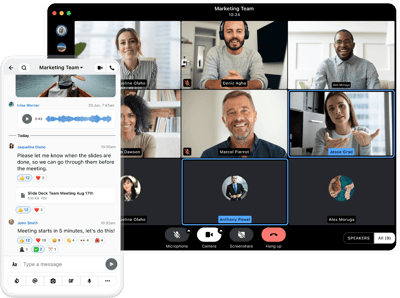
A ban asks staff to give something up. A replacement works when staff would choose it on their own. That means it has to feel as familiar as the app they are leaving. Messaging, calls, video, and file sharing belong in one place, on the phone in their pocket and the desktop in the office.
It also has to solve the problems WhatsApp creates rather than reproduce them. Wire registers users with an email address, so joining a work conversation never requires a private number. In April 2026, after a phishing campaign targeted politicians' Signal accounts, the President of the Bundestag recommended Wire to every member of parliament. Email registration was one of the reasons she gave. Through SSO and SCIM, Wire connects to the identity setup the municipality already runs. When a leaver's directory account is closed, their access to official conversations ends with it. IT can see who is in which conversation, and admin and governance controls are logged.
For staff using their own phones, Wire runs as a separate work app. Official conversations sit under the municipality's administration, while private contacts, photos, and chats stay private, which is usually the answer a works council is looking for. And because none of this needs a dedicated project team to run it, it fits an IT department that is already stretched.
Your staff did not choose WhatsApp to break the rules. They chose it because it works, and because it was already on their phone. What replaces it has to work just as well, with one difference that matters: the municipality can govern it.

Frequently Asked Questions