42% of organizations use WhatsApp for work. It's fast and familiar. But it wasn't built for business. Here's where the governance risk actually shows up
Ask anyone why they use WhatsApp for work and the answer is almost always the same: everyone's already on it.
That's true. WhatsApp has over two billion users worldwide. It's fast, familiar, and free. When you need to reach an external partner quickly, or coordinate with a colleague outside your usual tools, it's the path of least resistance.
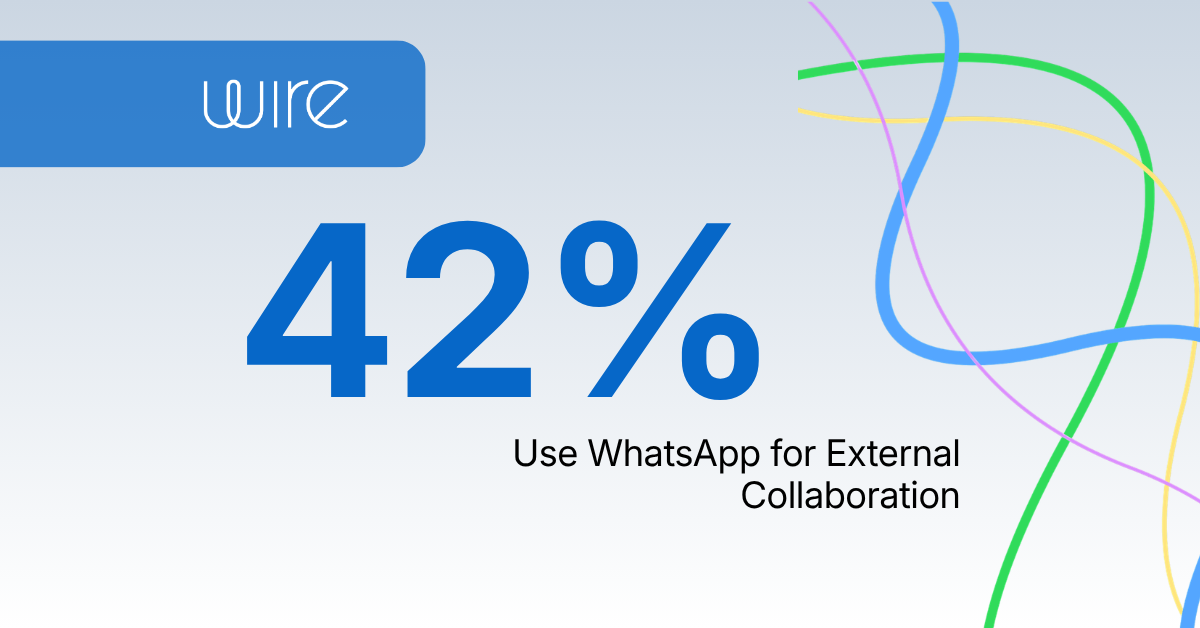
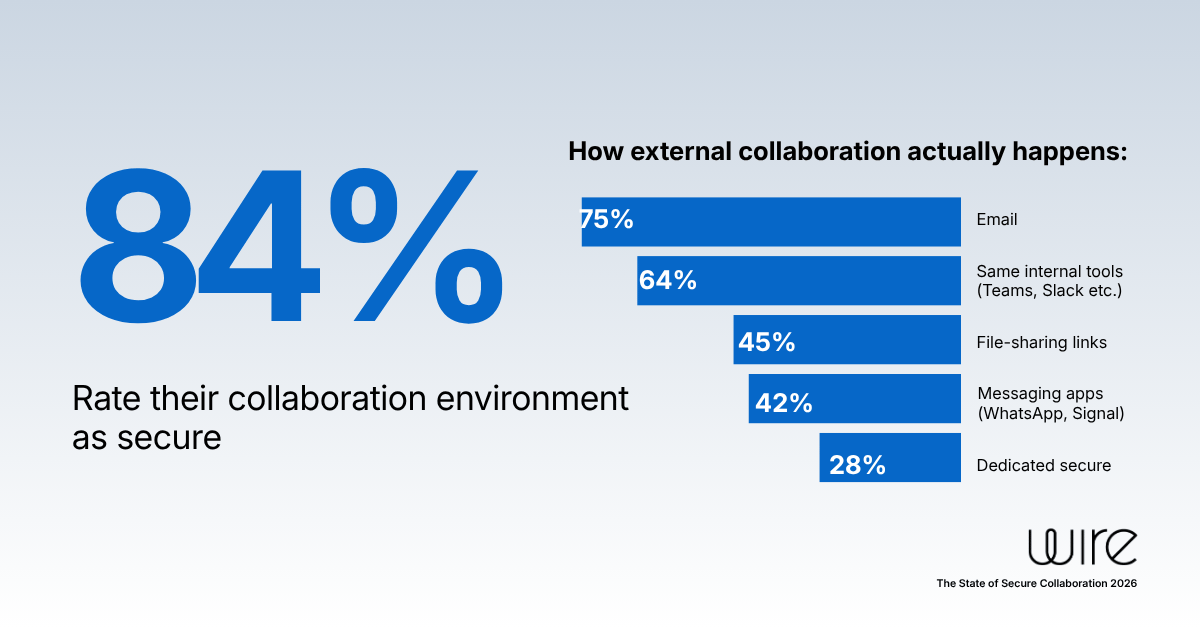
According to our recent survey, State of Secure Collaboration 2026, 42% of organizations currently use WhatsApp, Signal or similar consumer messaging apps for work collaboration. And 81% say that more than a quarter of their sensitive collaboration involves external participants.
Put those two findings together and you start to see the problem
Why employees reach for it
When someone shares a contract draft, a client update or a financial summary over WhatsApp, they're rarely doing something they know they shouldn't. They're solving a problem in front of them. The client isn't on Teams. The partner doesn't have access to your file-sharing system. The message needs to go now.
The issue isn't intent. It's that the tool they're reaching for was never designed for the context they're using it in.
WhatsApp was built for personal communication. It has no corporate account management, no centralized IT oversight, no audit trail, and no access controls that your organization can configure or revoke. When an employee uses it for work, they're operating entirely outside the governance boundaries your IT and security teams have built.
This is what the governance risk of consumer apps looks like in practice: not a dramatic breach, but a quiet, steady accumulation of organizational information in places no one can see or control.
Where the risk shows up in practice
The risks aren't theoretical. They show up in specific, predictable ways.
When someone leaves. An employee who used WhatsApp for client communication takes that entire conversation history with them when they leave. There's no way to revoke access, recover messages or audit what was shared. The information doesn't stay with the organization, it stays with the person.
When a project ends. File links shared over WhatsApp don't expire. A document sent to an external partner six months ago may still be accessible. Most organizations have no visibility into this, and no mechanism to close it.
When something goes wrong. If a compliance question arises, or an incident requires investigation, conversations that happened over WhatsApp are effectively invisible. There's no audit trail to pull, no access log to review, no record that IT can recover. The report found that 34% of organizations already find it difficult to identify who has access to sensitive files and that's inside their official tools.
When external partners are involved. Once information crosses into a partner's personal WhatsApp account, your organization loses control over it entirely. You can't see how it's stored, who else can access it, or where it goes next.
Why banning it doesn't solve it
Here's what makes this genuinely difficult to address: the survey data makes clear that employees don't bypass official tools because they don't care. They bypass them because those tools create friction at the exact moment they need to move fast.
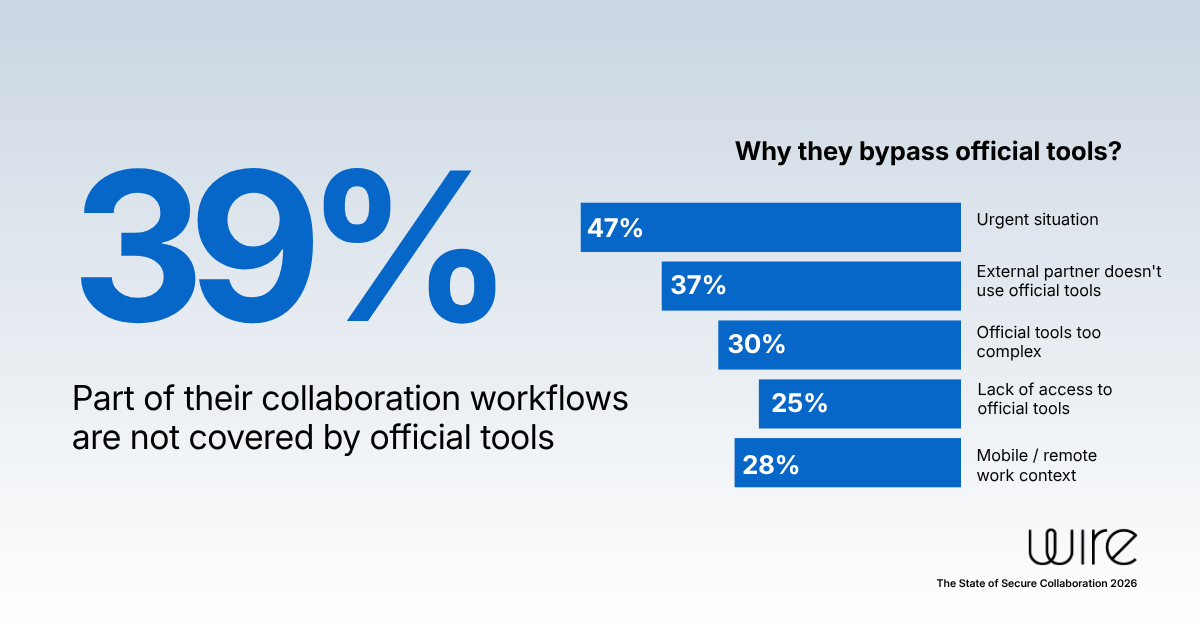
The most commonly cited reasons for reaching for unofficial tools were urgency, external partners not being on official platforms, and official tools being too complex. Lack of awareness barely registered as a factor.
That's an important signal. Restricting WhatsApp use without solving the underlying friction problem tends to push the behavior further out of sight, not eliminate it. Employees find other workaround.
The more productive question is what a governed alternative actually needs to look like? One that's easy enough for external participants to join, fast enough for urgent situations, and simple enough that the secure path is also the easy one.
The bigger picture
Consumer messaging apps sitting inside enterprise workflows is one of four structural risk areas that the State of Secure Collaboration 2026 identifies, alongside the security gap in mainstream collaboration tools, compliance readiness, and data sovereignty. None of these exist in isolation.
A sensitive file shared over WhatsApp with an external partner may also sit outside your data residency requirements, outside your audit framework, and outside your incident response capability at the same time.
If you want to understand how your organization's collaboration practices compare, and where the gaps are most likely to show up, the full report is available to download: