Explore the shift from legacy classified communication to modern secure collaboration, including VS-NfD requirements and digital sovereignty.
Digital collaboration has become the default way of working across business and government. Messaging, file sharing and real-time coordination are now central to how organizations operate. Yet for a long time, classified communication followed a very different path.
For VS-NfD and similar classifications, secure communication traditionally relied on tools designed for a much earlier digital era. Phone calls, basic text messaging and highly constrained systems were often the only approved options. These tools offered control and familiarity, but they did not reflect how modern work is actually done.
The legacy model: secure, but limited
Legacy approaches to classified communication were built around isolation. Security was achieved by restricting access, limiting functionality and separating classified environments from everyday digital workflows.
This model reduced risk, but it also introduced clear limitations:
- Collaboration was slow and fragmented
- Group communication was difficult to manage securely
- Information sharing did not scale well beyond small, predefined circles
- Users often had to switch between tools to complete everyday tasks
As digital work became more collaborative and time-sensitive, these constraints became increasingly visible. Security remained essential, but productivity suffered.
The shift toward modern digital work
The move toward modern classified communication is not simply about replacing old tools with new ones. It reflects a broader shift in how secure systems are designed.
Modernization means enabling secure communication that:
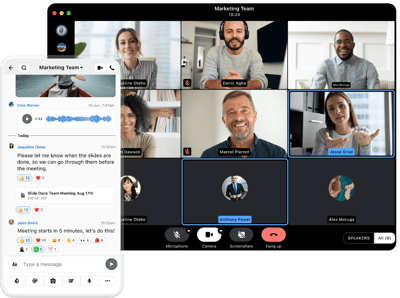
- Supports group collaboration rather than one-to-one exchanges only
- Works reliably across multiple devices
- Integrates into daily workflows without creating parallel systems
- Maintains security controls without requiring constant user intervention
For VS-NfD use cases, this shift required rethinking architecture, processes and responsibilities together. Secure communication could no longer be treated as a special exception. It needed to function as part of a broader digital work environment.
Security, sovereignty and usability converge
One reason modernization took time is that classified environments must satisfy multiple, sometimes competing requirements. Systems must be secure, legally compliant and operationally resilient. At the same time, they must be usable enough to be adopted correctly and consistently.
The VS-NfD framework sets a clear standard to which modernized secure communications must adhere. VS-NfD is a reminder that modernization doesn’t just mean increased openness or convenience alone. Instead, it sets conditions under which modern collaboration can take place without weakening security or sovereignty.
Modern security design in the context of digital collaboration must take into account that security failures often occur not because systems are too open, but because they are too difficult to use, which tempts users to bypass them and use insecure applications. Modern, compliant secure communications must therefore focus on embedding security into the design of communication systems rather than placing it on top as an additional constraint.
A structural change, not a one-time upgrade
Modernizing classified communication is not a single upgrade or rollout. It is a structural change in how secure digital collaboration is enabled and governed.
This includes:
- Clear security requirements defined at a national level
- Formal approval processes tied to specific use cases
- Systems designed for both protection and daily usability
- Ongoing responsibility for correct operation and configuration
The approval of modern communication systems for VS-NfD use signals that classified communication is no longer limited to legacy methods. It shows that secure digital collaboration can be achieved within clearly defined boundaries.