Signal's encryption held during the Bundestag phishing attacks, and the institution changed channels anyway. Here is what that means for security officers at defense suppliers.
In the defense sector, a messenger is only considered safe if it is approved. Encryption alone is not enough. While Signal's encryption is strong, it’s still a consumer app. It hasn’t been approved for nonpublic or classified defense information in Germany, the US, or France, and it doesn’t give organizations administrative control over accounts or messages. For a defense supplier, using it for program or contract work can put contracts and clearances at risk, even if no message is ever decrypted.
In April 2026, the President of the German Bundestag wrote to an address asking every member of parliament to use a BSI-certified messenger for official communication. The letter followed a phishing campaign that had compromised the Signal accounts of about 300 German politicians, military staff, and diplomats; including the President’s her Signal account. Signal's encryption held. The attackers didn’t need to break anything. They posed as support staff, asked for a PIN, and were let in. The Bundestag could have responded with a reminder to be more careful. Instead, it changed the channel.
If you are responsible for security at a defense supplier, that response deserves attention, as it changes the question your team needs to answer: Whether a consumer messaging app is encrypted matters less than whether it is approved.
Key takeaways
- Encryption and approval are different tests. Signal passes the first, but it is not approved for nonpublic or classified defense information in Germany, the US, or France.
- When attackers took over Signal accounts in the Bundestag in 2026, the encryption held, and the Bundestag still moved official communication to a certified messenger.
- Program conversations on consumer apps can cost a supplier programs, contracts, and clearances, because the organization cannot see, remove, or account for the information.
- An approved alternative only works if people keep using it, so it has to be as easy to use as Signal.
Why defense teams end up on Signal?
Nobody in the defense industry chooses consumer apps, like Signal, to cut corners. They choose it because it is the most security-conscious app on their phone: it’s end-to-end encrypted, free, and external partners are usually already using it. When a subcontractor needs an answer before a deadline, a Signal message feels like the more responsible choice. But that’s what makes it difficult to manage. A team on WhatsApp generally knows it is bending the rules. A team on Signal generally believes it is following them, because encryption feels like permission, and in day-to-day work nobody stops to check whether that’s true.
Is Signal approved for use for defense suppliers?
No, Signal is not approved for defense use, and it’s not because of its encryption.
Approval requires a different set of questions: who holds the decryption keys, are there administrative features, where the servers sit and under which jurisdiction, and whether an independent authority has evaluated the product for the classification level in question. Two apps can both describe themselves as end-to-end encrypted and give very different answers to all four.
The same logic applies in the United States. A 2023 Pentagon memo stated that unmanaged messaging apps, naming WhatsApp, Signal, and iMessage, are not authorized to access or transmit non-public Department of Defense information. When a Signal group chat among senior US officials became public in 2025, the inspector general's review centered on whether policy on commercial messaging apps had been followed. Investigators didn’t start with what was said, they focused on where it was said.
In Germany, the rules for restricted information (VS-NfD) and the applications recommended for handling restricted information set out how that material may be handled. The BSI publishes which products are approved to carry it. Companies working on classified contracts follow the same rules through the Geheimschutzhandbuch, the Federal Ministry for Economic Affairs’ handbook on protecting classified information in industry.
In March 2026, ANSSI, the French national cybersecurity agency, warned of an ongoing campaign against the Signal accounts of politicians and senior officials, using the same fake-support approach later seen in Germany. Its advice to public administrations was to move work conversations off consumer messengers altogether. That followed a 2023 instruction from the Prime Minister asking ministers and their advisers to replace apps like WhatsApp, Signal, and Telegram with state-approved alternatives.
What happens if sensitive defense conversations end up on Signal?
When sensitive defense conversations end up on Signal, the supplier loses control of program information. That can cost organizations programs, contracts, clearances, and reputation. These conversations aren’t trivial. They are delivery schedules, test results, specifications, and the daily exchange with partners and subcontractors that keeps a program moving. When that information sits in a consumer app like Signal, the organization cannot see who has it, cannot remove it when someone leaves, and cannot show where in the case of an investigation. In defense, even a whisper of impropriety can call an organization's ability to be trusted into question. That’s enough to ruin them.
Partners add to the pressure. Every organization on a program brings its own default tool, and conversations tend to follow whichever one is easiest for the person starting them. Without an approved channel that partners can join easily, the gap gets filled with long email threads. Or in the worst case, the consumer app everyone already has.
How do you get your people off Signal?
Your team stops using Signal when the replacement is as quick and familiar as Signal, and the real test is whether people are still using it a month later. Most security officers have seen what happens when the approved tool is difficult to use: people nod their heads in the policy meeting, and then return to consumer apps like Signal afterward. Defeating the whole purpose of the policy and keeping the organization and its people at risk.
Lateration GmbH’s is an example of how a good replacement keeps teams off Signal. Lateration is a German defense company of around 50 people, handling highly sensitive operational military intelligence for its customers. Its contracts depend on the confidence that what customers share stays protected. As the company puts it, discretion is key.
Lateration had been using Microsoft 365, where end-to-end encryption was only available as a paid add-on. Over time, that dependency began to look more like a risk than a convenience. So the company chose Wire and made it the mandatory channel for all sensitive communication.Its most sensitive conversations now run through Wire by policy, and the team still uses it, because the channel they were asked to use is one they would have chosen anyway.
The decision also gave Lateration something it had not set out to find: a communication channel that stays available if the primary IT environment goes down. In defense planning terms, that is an alternate path in a PACE plan, already in place before anyone needs it.
What should defense suppliers look for in a Signal Alternative?
Defense suppliers should look for a messenger that is approved for their classification level, runs in an environment they control, lets partners join without leaving that environment, and is as easy to use as Signal. Approval comes first, and this is where the Bundestag's recommendation comes back into the story. The messenger it recommended was Wire, and the approval behind that recommendation belongs to Wire Bund, the government edition of Wire. Germany's Federal Office for Information Security (BSI) has approved Wire Bund for information classified up to VS-NfD (BSI-VSA-10928). That approval is valid until the end of 2028.
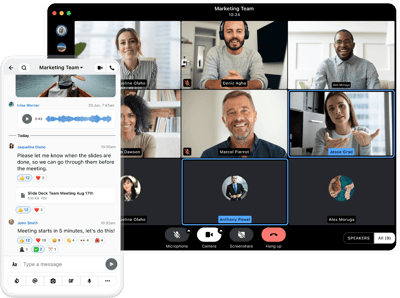
Approval is the first requirement, but it’s not the only one. Organizations handling program information also need control over where the platform runs, which on-premises and private cloud deployment provide. They need partners and subcontractors to be able to join program conversations as external participants, so that including them does not mean leaving the approved environment. And they need messaging, calls, video, and file sharing in one app that people are comfortable using on mobile and desktop, because an approved channel that is slower than Signal, will eventually lose to Signal.
In practice, approval without usability produces a policy nobody follows, and usability without approval basically just Signal all over again.
Signal does what it promises, which is to encrypt. For a defense supplier, that’s not enough. The channel your team uses has to be one you can defend when someone asks where a conversation took place, and one your team keeps using when nobody is asking.

Frequently Asked Questions