Cyberattacks aren’t just becoming more frequent, they’re becoming more precise. Threat actors now use AI-driven phishing, credential harvesting, and business email compromise to exploit the weakest link in the chain: human error. Unfortunately, traditional communication tools like WhatsApp, MS Teams, or Slack do not ensure end-to-end encryption of all chats, files, videos, calls, and metadata and were never designed for secured enterprise use cases. They rely on centralized server architectures that expose metadata and can be subject to extraterritorial access under laws like the CLOUD Act.
This is why enterprises are shifting to encrypted messaging apps. They ensure that only the intended recipients can access the information, whether that’s an incident response update, a board discussion, or a cross-border negotiation.
This article explains how encrypted messaging works, why encryption alone isn’t enough anymore, and what features modern enterprises should look for when choosing a secure communication solution.
What Is an Encrypted Messaging App?
An encrypted messaging app uses end-to-end encryption to ensure that messages, calls, files, and other data can only be read or accessed by intended recipients. Encryption keys are stored only on user devices, like Wire, and not on central servers, preventing potential breaches or external access. This ensures that even service providers cannot access any data shared on the platform.
Encrypted messaging apps typically protect:
- Text messages
- Voice and video calls
- File sharing
- Group conversations
- Attachments and media
- Identity and session data
The foundation of this protection is end-to-end encryption (E2EE), but not all E2EE implementations are created equal.
Here are some leading messaging and collaboration platforms that offer end-to-end encryption.
How Do Encrypted Messaging Apps Work?
Encrypted messaging platforms leverage cipher algorithms and cryptographic protocols like Messaging Layer Security (MLS) or the Signal Protocol to secure messages before they are sent.
In practice, this means:
- Your device encrypts the message before sending it.
- The encrypted message travels across the network.
- Only the recipient’s device can decrypt it.
- The provider cannot read or access any part of it.
The MLS protocol goes one step further to use group-oriented encryption that helps secure large-group chats, calls and files. Together with zero-trust policies and multi-device security, this approach helps protect both content and metadata and provides strong confidentiality.
Why Businesses Need Encrypted Messaging Apps
Enterprises face risks that consumer tools (Teams, Slack and WhatsApp) were never built to handle. The rise in targeted phishing, insider threats, compromised credentials, and supply-chain attacks means sensitive conversations can’t rely on traditional IT stacks.
Businesses require:
- Protection beyond message content
Even if the message content is encrypted, information about who is talking to whom, when, and how often (metadata) can still be exposed. In 2025, enterprises across the world faced more than 5000 cyberattacks per day and 91 percent of all breaches were caused by human error. Hackers know that even the most robust enterprise defenses can be breached by exploiting employee errors and security lapses. And they are now exploiting LLM tools to launch hyper targeted and personalized attacks. In fact, AI-powered phishing emails are now the top breach method. For enterprises and governments, metadata leaks can be as damaging as content leaks.
- Compliance with EU regulations
Increasing regulatory compliance amplifies the stakes. Frameworks like GDPR, NIS2, and DORA mandate strict standards for data protection, transparency, and auditability, especially in sensitive sectors such as finance, energy, and healthcare. Non-compliance leads not only to regulatory fines but also to a loss of customer trust.
- Modern messaging and collaboration tools
Organizations need enterprise-grade control, including role-based access, integrations, and flexible deployment options (cloud, private cloud, on-prem), as well as secure collaboration at scale with support for large groups, dynamic membership, and multi-device workflows without performance or security trade-offs.
This is where next-generation protocols like Messaging Layer Security (MLS) come in.
What Is MLS (Messaging Layer Security)?
MLS is a modern, IETF-standardized protocol designed for large-scale, enterprise-grade, end-to-end encrypted group communication.
It solves several limitations of traditional encryption approaches:
Why MLS is a game-changer:
- Optimized for large groups: E2EE without performance degradation.
- Dynamic membership: users can securely join or leave groups without rebuilding encryption keys from scratch.
- Multi-device support: a secure, efficient way to use multiple endpoints.
- Better forward secrecy and post-compromise security — keys update automatically and frequently.
- Designed for enterprise environments: works across servers, regions, and deployments.
MLS represents the next stage of secure messaging, future-proofing encrypted communication for global organizations.
Key Features to Look for in a Secure Messaging App
Not all encrypted messaging apps provide the same level of protection. Enterprises should evaluate tools based on both cryptographic strength and operational suitability.
Essential security features
- True end-to-end encryption
Protects all content by default, with no fallback to server-side encryption.
- Metadata protection
Limits who can see interaction patterns, group membership, or communication frequency.
- MLS support
Ensures scalability, multi-device efficiency, and future-proof security.
- Forward secrecy & post-compromise security
New keys are frequently generated to limit the impact of compromise.
- Identity verification
Prevent account impersonation and man-in-the-middle risks.
Enterprise-level capabilities
- On-prem, private cloud, or sovereign EU hosting
- Role-based access controls and centralized management
- SSO, SCIM, and enterprise provisioning
- Audit logs and compliance controls
- Integration with existing IT workflows
- Open-source transparency (where available)
These capabilities separate consumer-grade apps from enterprise-ready secure communication platforms.
Choosing the Right Encrypted Messaging App for Your Organization
When evaluating vendors, organizations should consider the following questions:
a) Security
- Is the app fully end-to-end encrypted for all message types?
- Does it protect metadata?
- Does it support MLS or an equivalent modern protocol?
- Is the code open to independent verification?
b) Compliance & Sovereignty
- Where is the data hosted?
- Is the provider subject to extraterritorial laws (e.g., CLOUD Act)?
- Does the solution align with GDPR, DORA, and NIS2 requirements?
c) Deployment & Control
- Can we deploy on-premises or in a sovereign cloud?
- Do we have control over user management and authentication?
- Can we integrate it with our identity provider?
d) Usability & Adoption
- Is the app intuitive enough for company-wide use?
- Does it support large group conversations without performance issues?
- Does it offer multi-device sync?
A strong encrypted messaging solution should satisfy all four dimensions—security, compliance, control, and usability.
A Look at the Leading Enterprise Encrypted Messaging Apps
While many consumer apps offer encryption, only a handful of platforms are built for enterprise requirements. Here’s a high-level overview of some well-known options.
Wire
A secure, enterprise-grade communication platform offering full end-to-end encryption, metadata protection, MLS support, on-prem deployment, and EU data sovereignty. Designed for highly regulated sectors and mission-critical use cases.
Element
An open-source collaboration tool built on Matrix. Offers strong encryption and federation but requires more technical maintenance compared to turnkey solutions.
Threema Work
A privacy-focused messaging app with strong encryption and Swiss hosting. Limited enterprise automation and collaboration features compared to full platforms.
Nextcloud Talk
Part of the Nextcloud collaboration suite; offers encrypted communication capabilities, especially for organizations already using Nextcloud. Not as feature-rich as dedicated secure messaging platforms.
Conclusion: Secure Messaging Is Becoming a Business Standard
Encrypted messaging apps are no longer niche security tools—they’re becoming essential for organizations that handle sensitive conversations or operate in regulated environments. With attackers increasingly targeting communication channels, enterprises need solutions that go beyond basic E2EE and offer metadata protection, modern protocols like MLS, flexible deployment models, and full alignment with EU sovereignty requirements.
Choosing the right platform is no longer just a technical decision. It has become a strategic one that directly impacts resilience, compliance, and long-term business continuity.
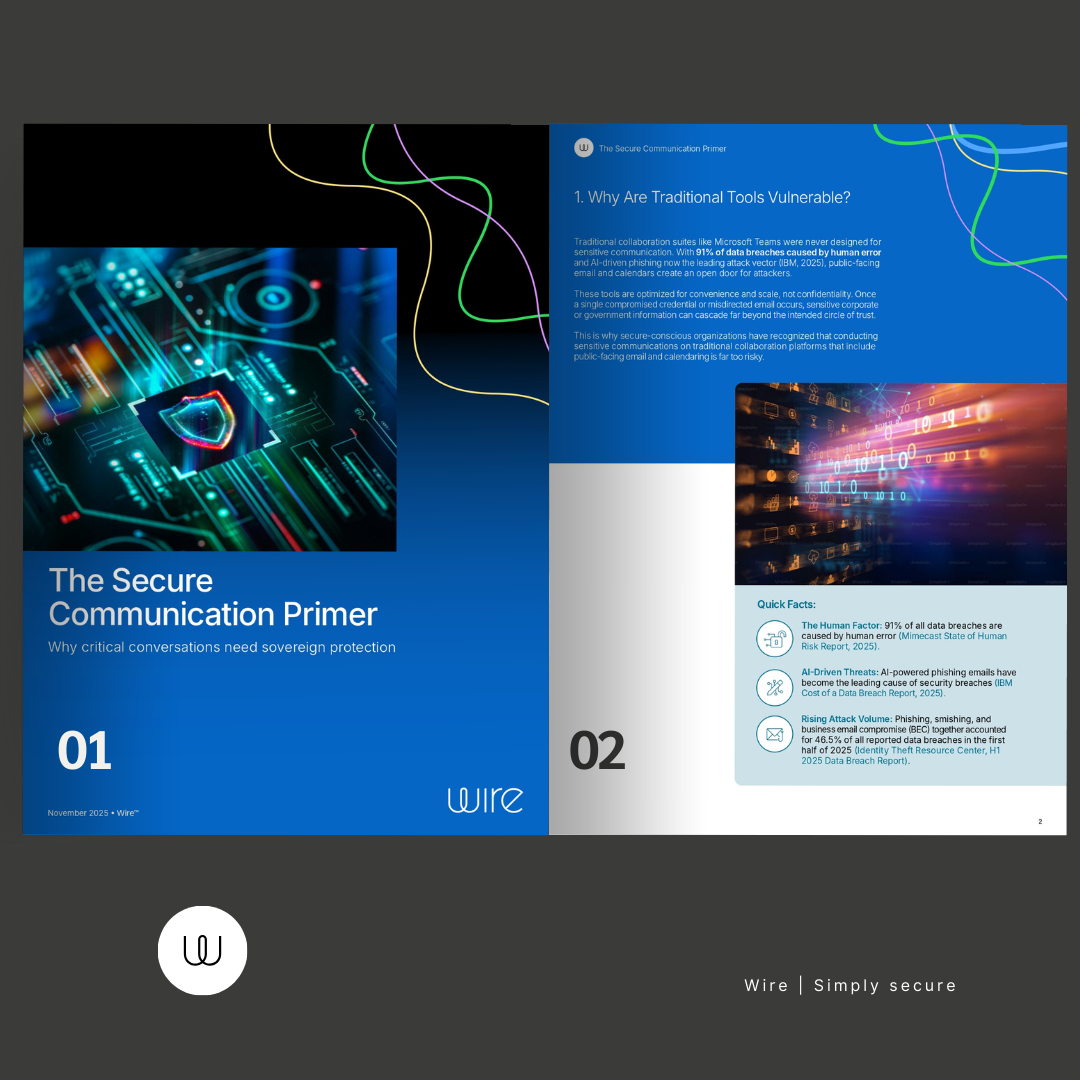
Explore the Secure Collaboration Primer or discover how encrypted communication can fit into your compliance strategy.