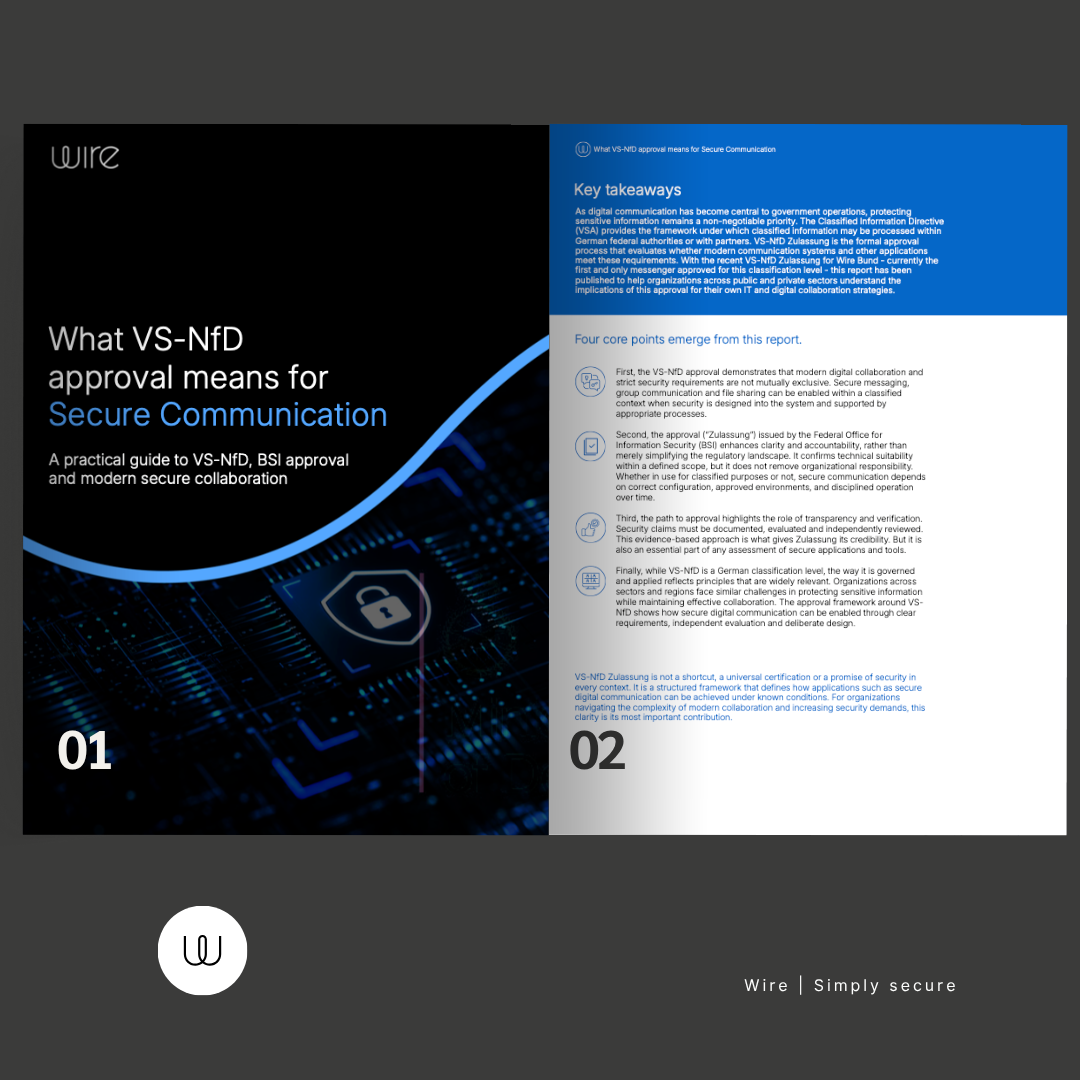
Understand VS-NfD and BSI Zulassung: what approval confirms, its limits, and why it matters for secure digital collaboration. All explained in this blog article.
Wire Bund has received VS-NfD Zulassung from the German Federal Office for Information Security (BSI).
This approval allows Wire Bund to process communication classified as Verschlusssache - Nur für den Dienstgebrauch (VS-NfD) within a defined scope.
But what does that actually mean?
To understand the significance of Zulassung, it is important to understand the framework behind it and its limits.
1. What Is VS-NfD and Why Does It Exist?
Definition of VS-NfD
VS-NfD stands for Verschlusssache - Nur für den Dienstgebrauch, translated as Classified - For Official Use Only. It is the lowest level within the German federal classification system.
“Lowest level” does not mean low importance. Information classified as VS-NfD must be protected because unauthorized disclosure could harm public interests, even if it does not pose an immediate threat to national security.
VS-NfD applies to internal government communication, operational coordination and sensitive exchanges with authorized partners.
Why It Exists: Protecting Public Interest
Classification frameworks exist to define how sensitive information is handled.
In the case of VS-NfD, the objective is clear:
- Prevent unauthorized access
- Maintain operational integrity
- Protect public institutions from avoidable harm
It is not about secrecy for its own sake. It is about accountability and controlled handling of information that affects public administration, infrastructure and governance.
The Legal Framework: VSA and VS-NfD Merkblatt
VS-NfD handling is governed by binding regulations:
- Verschlusssachenanweisung (VSA): the Classified Information Directive issued by the Federal Ministry of the Interior
- VS-NfD Merkblatt: specific guidance for processing and protecting VS-NfD information
The Shift: Digital Communication Expands the Risk Surface
Public institutions increasingly rely on digital communication tools for messaging, file sharing and real-time collaboration.
This shift has expanded the attack surface. Sensitive communication is no longer limited to controlled physical environments. It moves across devices, networks and distributed teams.
At the same time, geopolitical tensions, cyber threats and dependencies on foreign providers have intensified concerns around sovereignty and control.
VS-NfD provides a structured framework for enabling digital collaboration without weakening protection requirements.
2. What Does VS-NfD Approval Confirm and What it Doesn’t?
In the context of VS-NfD, Zulassung refers to a formal approval issued by the BSI. It confirms that a specific IT system may be used to process VS-NfD classified information within a defined scope.
What VS-NfD Confirms
A VS-NfD Zulassung confirms that:
- The solution meets the defined security requirements for the VS-NfD classification
- Security concepts and technical documentation have been evaluated
- Independent testing has been conducted
- The system may be used within the approved configuration and operational environment
Importantly, the approval is always tied to:
- A specific product version
- A defined deployment scenario
- A clearly described scope of use
It is a structured, evidence-based approval decision.
What VS-NfD Does Not Confirm
Equally important are the limits.
VS-NfD approval does not mean:
- All versions or deployments of a product are approved
- The product is automatically suitable for higher classification levels
- Security is guaranteed outside the approved configuration
- Organizational responsibility is transferred from the operator to the vendor
Approval confirms technical suitability under defined conditions. It does not replace governance, secure infrastructure or disciplined operation.
This precision is intentional. Classified communication requires clarity about scope and accountability.
Got questions?
3. Why It Matters for Secure Collaboration
For many years, classified communication relied on legacy tools designed for isolation rather than collaboration.
Modern work, however, depends on:
- Group messaging
- File sharing
- Voice and video communication
- Multi-device access
The challenge has been enabling these capabilities without lowering security standards.
VS-NfD Zulassung demonstrates that modern digital collaboration can be aligned with sovereign-grade requirements when security is embedded into architecture and verified independently.
This is not a marketing claim. It is a structural shift.
Secure collaboration at the VS-NfD level requires:
- End-to-end protection
- Controlled identity and access management
- Defined operational boundaries
- Continuous responsibility for correct deployment
The approval shows that secure messaging and real-time collaboration can operate within these constraints when designed deliberately.
4. What It Signals Beyond Government
VS-NfD Zulassung is a national security approval issued within the German federal framework. By definition, it applies to a specific classification level, a defined product version and a clearly described operational environment. It does not extend beyond that jurisdiction, nor does it replace regulatory or certification requirements in other countries. It also does not constitute a blanket validation of an organization’s overall security posture.
Its broader relevance lies in the approach it represents.
The VS-NfD approval demonstrates how secure communication systems can be evaluated against explicit and publicly defined requirements.
Security claims must be translated into:
Approval is not based on marketing assurances or generalized compliance statements, but on structured assessment within a clearly limited scope. This emphasis on precision and bounded applicability is central to the credibility of the process.
For organizations outside the German federal environment, the classification itself may not apply. However, many sectors, including critical infrastructure, defense, healthcare, finance and other regulated industries, face comparable pressures to protect sensitive information while maintaining operational efficiency. In this context, the VS-NfD approval serves as a reference point for how secure digital collaboration can be governed, assessed and controlled under strict requirements.
It does not offer equivalence or automatic transferability. Rather, it provides orientation. It illustrates how sovereignty, technical architecture and operational responsibility can be aligned in a coherent framework. At a time when geopolitical tensions, supply chain dependencies and regulatory scrutiny are reshaping technology decisions, independently verified security approvals carry significance not because they are universal, but because they are explicit about their limits.
The broader signal of VS-NfD Zulassung therefore lies in the clarity of its methodology. It shows that modern digital collaboration can be subjected to structured evaluation without abandoning usability, and that security assertions can be tied to verifiable conditions rather than abstract promises.