Cybersecurity risk in digital collaboration covers phishing, insider misuse and unmanaged integrations. See the risks and how to reduce them.
What is cybersecurity risk in digital collaboration?
Cybersecurity risk in digital collaboration is the exposure to harm or the potential loss that comes from using messaging, calling, conferencing, and file-sharing tools to run day-to-day work. It covers the potential for data theft, unauthorized access, service disruption, and compliance exposure tied to a compromised, misconfigured, or ungoverned collaboration tool. The risk includes deliberate attacks such as phishing or credential theft, and non-malicious causes such as human error or a misconfigured third-party integration.
Cybersecurity risk is generally expressed as risk = likelihood × impact: the probability that a threat exploits a vulnerability in a collaboration tool, multiplied by the damage that follows if it does. Applied to collaboration specifically, likelihood rises with the number of integrations, guests, and unmanaged apps connected to a workspace, and impact rises with how much sensitive material moves through that workspace on a given day.
Why collaboration tools carry this risk specifically
Sensitive work has moved. Decisions, contracts, credentials, and confidential conversations that once lived in email or in a locked filing cabinet now move through chat threads, video calls, and shared drives, often across a dozen tools an organization did not choose, all at once. The attack surface has grown to match, and it has grown faster than most security programs have kept pace with.
Traditional perimeter security was built to protect a network boundary, not a conversation. A firewall does not know what is being said inside an encrypted or unencrypted chat, and it has no visibility into a guest account added to a channel last week or a bot integration installed without IT's sign-off. This is the asymmetry at the center of collaboration risk: large, highly connected organizations run more tools, more integrations, and more external participants than security teams can individually vet, and the gap between the two keeps widening.
Our overview of what to look for in a secure communication platform for enterprises lays out why this shift changes what "secure" needs to mean for a collaboration tool specifically, and the deeper look at how encrypted messaging apps actually work explains the mechanics behind the piece of this problem that encryption is built to solve, separate from the governance and access questions covered later in this guide.
Common cybersecurity risks in collaboration tools today
These risks show up in a fairly consistent pattern across organizations, regardless of size or sector. Each one maps to a specific point where a collaboration tool's design, rather than the network around it, determines whether an attacker succeeds.
Shadow IT and tool sprawl
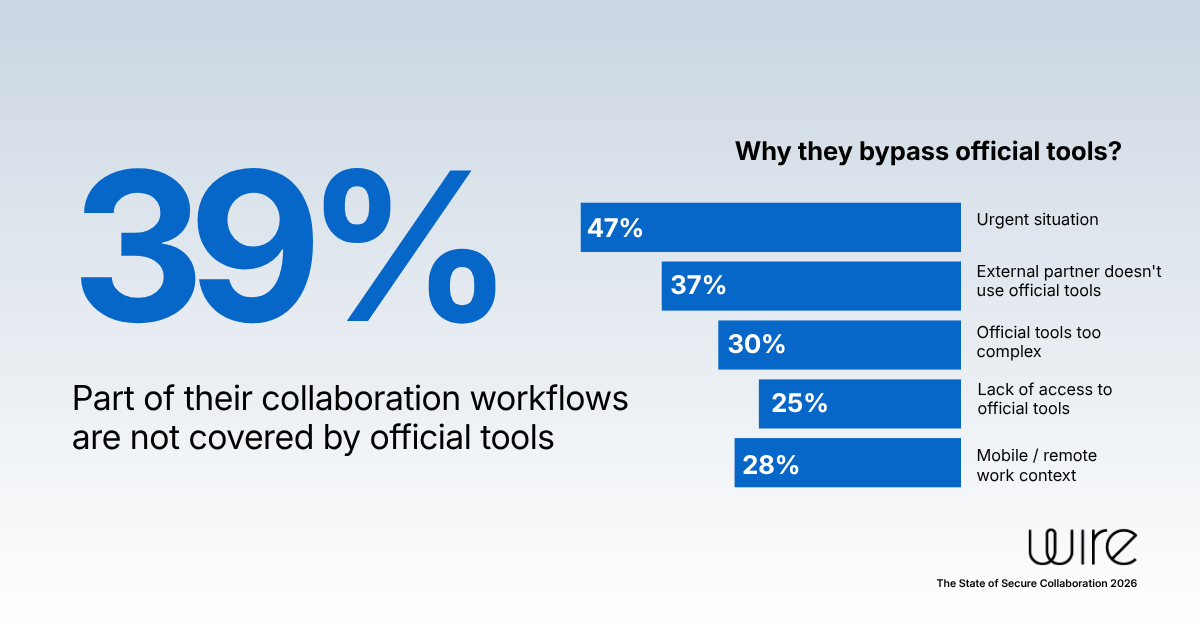
When official tools have workflow gaps, employees route around them. Our 2026 State of Secure Collaboration survey found that 42% of organizations already use consumer apps for work, and 39% cite gaps in their official tools as the reason. Each of those unsanctioned channels sits outside IT's monitoring entirely, as we found first-hand in a real Slack-based espionage attempt, and it's the same gap we walk through closing in our guide to choosing a Skype for Business alternative.
Unmanaged third-party integrations and bots
Every bot or app connected to a collaboration workspace inherits a slice of its trust, and few organizations audit that access on an ongoing basis. IBM's 2025 research found third-party and supply-chain compromise to be the second-costliest initial breach vector, at close to USD 4.91 million per incident. It's why we built our Integrations SDK to govern that access by default, down to how developers can build secure apps inside encrypted conversations without ever widening the trust boundary.
Guest and external-participant access with no audit trail
Open guest links and unsolicited invites give attackers an easy way to scope out a target and slip malicious content in before anyone questions who they are; the 2025 Data Breach Investigations Report again found phishing to be the most common confirmed way attackers first get in. We think about this the moment guests are present in a conversation, and it's the same reasoning behind treating federation as a security question rather than just a spam one.
Phishing and social engineering targeting collaboration accounts specifically
This risk has accelerated specifically because of AI. IBM's 2025 data shows AI-generated phishing now behind 37% of incidents and deepfake impersonation behind 35%, both rising fast, a shift we've tracked closely in our 2025 cybersecurity trends roundup, and one we've also written practical guidance on for government officials navigating especially targeted campaigns.
Credential takeover and insider or admin misuse
Stolen credentials remain one of the most direct paths into a collaboration environment, and CrowdStrike's 2026 threat research points to a continued rise in credential-based, malware-free attacks that never trip traditional malware detection. Insider misuse carries its own weight too: IBM found malicious insider incidents averaging USD 4.92 million, the costliest initial vector measured for the second year running.
No containment once one account or channel is compromised
Even a well-defended workspace can be reached, and what happens next depends entirely on whether that workspace is segmented. Without containment, one compromised account or channel can cascade into everything connected to it. The pattern we saw play out in the Salt Typhoon hack and again in the AT&T and Verizon China hack, where encryption alone wasn't the whole story.
AI assistants ingesting conversation content without access controls
As AI assistants become regular participants in collaboration workspaces, they inherit access to whatever they're connected to unless that access is deliberately scoped. IBM's 2025 research found that 97% of AI-related breaches involved AI systems lacking proper access controls in the first place, and unsanctioned "shadow AI" added roughly USD 670,000 to the average breach cost.
Metadata exposure even when message content is protected
Even where message content is well protected, metadata (who spoke to whom, when, and how often) can still reveal a great deal, and it is often the piece organizations forget to consider. Our explanation of why most business communication is still unencrypted touches on why content protection alone was never meant to be the whole answer.
How to think about this risk
Most cybersecurity content treats every attack as one event: a breach happens, or it doesn't. In practice, an attack is closer to a sequence, and the framework we use internally to think about cybersecurity risk, the Unified Kill Chain, first published by researcher Paul Pols in 2017, is built around that idea. It breaks an attack into eighteen phases, but the more useful way to think about it is as three broader stages: getting in, moving around once inside, and getting something out.
Getting in
Everything before an attacker has a real foothold: scoping out a target, finding a way to reach someone, and delivering whatever gets them through the door. For a collaboration tool, this is the guest link nobody revoked, the phishing message that looks like it came from a colleague, or the bot integration nobody reviewed before approving it. Most cybersecurity spending goes toward this stage, and for good reason — it's the cheapest place to stop an attack, before it has anywhere to go.
Moving around
Is what happens after that initial foothold. An attacker rarely finds what they want on the first account they compromise, so they look for a way to reach further: a privileged admin role, a channel with broader membership, a credential that opens more doors than the one they started with. This is the stage that decides how bad a breach actually gets. A workspace where every account can reach everything turns one compromised login into total exposure. A workspace built around segmentation and least-privilege access turns the same compromised login into a contained, much smaller problem.
Getting something out
Is the objective: the data leaves, the ransomware deploys, the impersonation attempt succeeds. This is also, not coincidentally, the stage most detection tools are built to catch, which is why it fails so often: by this point, an attacker has already had the run of the place.
The reason this framing is worth using at all is that it changes where attention goes. A lot of collaboration security still concentrates almost entirely on the first stage, keeping people out, and treats what happens after a compromise as someone else's problem.
How to reduce cybersecurity risk in collaboration
Reducing this risk starts with treating your collaboration platform as part of the security stack, not just a productivity tool sitting outside it.
Run a Security Audit on Your Collaboration Tools Specifically
Most security audits focus on the network and endpoints. Collaboration tools rarely get the same scrutiny, despite carrying just as much sensitive material. A proper audit should cover:
- Every integration, bot, and third-party app with live access to a workspace, and who approved each one
- Guest and external-participant access, and whether any of it has been sitting open without expiry
- Admin permissions, and whether any admin account can read message content it doesn't need to see
Learn From What's Already Gone Wrong
The Colonial Pipeline attack in 2021 started with a single compromised VPN password and ended with a shutdown of fuel supply across the Eastern US and a ransom paid in Bitcoin. The entry point wasn't sophisticated. It was a credential that should have needed more than a password to use. Collaboration tools carry the same risk on a smaller scale: a stolen login into a messaging platform can expose exactly the kind of sensitive, informal conversation that never makes it into a formal document, and is rarely covered by the same access controls as the systems around it.
Build a Response Plan That Assumes the Primary Platform Might Be Down
If the incident response plan only exists inside the platform that just got attacked, it isn't a plan. A resilient setup includes a communication channel that's architecturally independent from the primary collaboration suite, so a team can still coordinate if Teams, Slack, or email goes down in the same incident.
| Best practice |
Why it matters |
How Wire delivers it |
| Deploy zero-trust architecture |
A valid credential alone should never be enough to reach sensitive conversations
|
SSO and MFA paired with certificate-based device verification through Wire ID Shield, so a correct password isn't enough on its own |
| Encrypt communications end-to-end |
A compromised server or piece of shared infrastructure should yield nothing readable |
The only full production implementation of MLS, the open IETF standard, applied by default across messages, calls, and video |
Scope access by role
|
A compromised account or coerced admin should only reach what that role actually requires, not the entire workspace |
Admins can manage users and policy without ever reading encrypted content; conversation membership is explicit, not inherited |
| Review third-party integrations before approving them |
Bots and integrations shouldn't get a standing exception to the platform's security model |
The Integrations SDK keeps bots and AI assistants operating inside the same encrypted boundary as the rest of a conversation |
| Give employees a sanctioned tool that's good enough to use |
If the approved tool has gaps, people route around it toward consumer apps with none of these controls |
The same reasoning behind why 1,800+ organizations run Wire in place of consumer messaging apps |
| Keep audit logs detailed and exportable |
An incident should be reconstructed, not guessed at, after the fact |
SIEM-compatible, exportable audit logs built to support a real investigation |
Review This Regularly, Not Once
Threats, integrations, and staff access all change constantly. A collaboration security review that happens once a year is already out of date by the time the next audit comes around.
Closing
The tools people use to talk, share files, and make decisions carry exactly the sensitive material attackers are after: contracts before they're signed, incident details before they're public, credentials shared in a hurry. Getting this right means closing off how attackers get in, limiting how far they can move once they're inside, and making sure something usable survives even when the first two lines don't hold.
A few things are worth holding onto from this guide:
- Risk comes down to likelihood and impact together, and both are shaped by how a collaboration tool is built
- An attack is a sequence — getting in, moving around, getting something out — and the middle stage is where most of the actual damage gets decided
- The practices that reduce this risk are concrete and well established: zero trust, end-to-end encryption, scoped access, reviewed integrations, and logs that hold up under real scrutiny
None of this removes risk entirely. What it does is change how far a single mistake, a single stolen credential, or a single unreviewed integration is able to travel before someone notices.
See how Wire applies these principles across messaging, calling, and file sharing →
Frequently Asked Questions