IT leaders must consider four key risks to digital collaboration: cybersecurity, shadow collaboration apps, compliance, and sovereignty
Digital collaboration, including messaging, conferencing, and content collaboration, has become the connective tissue of modern organizations. But for IT, cybersecurity, and compliance leaders, that connective tissue has also become a growing liability because of a gap between their perceptions and the reality of risk.
As reported in Wire’s recent State of Secure Collaboration research report, 84% of IT and security leaders considered their collaboration environments to be secure, yet 48% also reported that sensitive conversations were routinely happening in insecure tools. In this article, we cover four converging risks that are forcing a fundamental rethink of how organizations build their digital workspaces, making the cost of inaction increasingly unacceptable.
Risk 1: Cybersecurity Threats Are Outpacing Your Perimeter
The threat landscape has never been more dangerous or more targeted. Attackers are going after intellectual property, PII, regulated data, classified communications, and the IT systems that hold it all together. AI-powered phishing and social engineering have lowered the barrier to successful attacks, while supply chains remain a chronically under protected entry point into even the most security-conscious enterprises.
The result is a fundamental asymmetry: large, highly connected organizations face an attack surface that grows faster than they can defend. Traditional perimeter security cannot solve this. What's needed is segmentation at the collaboration layer itself: channels in which sensitive conversations, document work, and decisions are protected end-to-end, regardless of where an attacker has already gained a foothold.
The perimeter of collaboration apps itself has become an entry point for attackers, as unsecured third-party app extensions and too-easy guest invites have become the norm. In Wire’s research, IT and security leaders selected cybersecurity threats as the biggest risk point to their digital collaboration systems.
Risk 2: Shadow Collaboration Apps are a Ticking Governance Time Bomb
Walk through any enterprise today, and you will find collaboration happening on WhatsApp, Signal, and shadow collaboration apps that no IT policy formally sanctions. They're so common that they are effectively part of enterprise infrastructure. The motivations are understandable: these tools are fast, familiar, and free. But the organizational risks are severe.
According to Wire research, turning to consumer apps is the outcome of a gap between the needs of users, particularly in timely coordination between internal and external parties, and the obstacles that traditional enterprise collaboration systems present. Without an integrated corporate alternative that meets real needs for boundaryless collaboration and productivity, employees will continue to turn to WhatsApp and other consumer tools. Allowing this to persist means IT and security teams are leaving a wide-open door to data breaches through social engineering attacks and human error leaks. In addition, the use of consumer apps creates significant HR and legal exposure for organizations due to the mixing of private and work communications, which can enable unsupervised, inappropriate behavior.
According to Wire research findings, IT and security leaders ranked shadow consumer app usage second only to overall cybersecurity threats as a risk to their digital collaboration systems. It is the biggest, specific risk point, but the good news is that Wire is designed and proven successful in replacing shadow collaboration apps.
Risk 3: Compliance Exposure is No Longer Theoretical
GDPR, NIS2, HIPAA, DORA. The regulatory landscape has thickened considerably, and the financial exposure from noncompliance is real and growing. Regulators expect demonstrable control over how sensitive data is handled, shared, and protected across everyday collaboration workflows. Critically, inadvertent leakage of protected data carries the same legal weight as an intentional breach. Regulators do not distinguish between negligence and malice.
For critical national infrastructure (CNI) organizations, NIS2 has raised the stakes further: proof of encrypted systems and resilient crisis communications is now a requirement, not a best practice.
When you consider the weight of external cybersecurity threats, and the prevalence of shadow IT consumer app usage, it is natural to anticipate that regulatory concerns will follow. Any data breach involving insecure, non-governed tools is a major exposure to steep compliance fines.
According to Wire research, IT and security leaders ranked compliance third in their overall risk assessment for digital collaboration.
Risk 4: Sovereign Risk and Loss of Control Over Critical Data
CEOs, CFOs, and CIOs are increasingly alert to a risk that has historically flown under the radar: structural overdependence on non-sovereign, uncontrolled cloud platforms. When your organization’s data and work productivity depend on infrastructure controlled by foreign-headquartered technology companies, it is technically and legally exposed to access by foreign governments under those jurisdictions' laws.
This is not a hypothetical. It is a structural condition that every organization using US-headquartered hyperscalers must account for, particularly in regulated sectors, defense supply chains, and public administration. IT and security leaders see sovereignty as a real concern, as it showed up fourth in their ranking of risks to digital collaboration in the Wire survey research.
For some organizations, any public cloud or SaaS infrastructure simply isn’t transparent enough in its administration and data handling to satisfy organizational imperatives. They need platforms that can be deployed on-premises by trusted partners, ensuring they’re always in control of their data end-to-end.
What Success Requires
Addressing these four risks simultaneously demands a new model for the digital workspace. Six requirements define what that model must deliver.
-
End-to-end encryption as the foundation. Not as optional, not as a premium add-on. E2EE creates a segmented, high-security channel layer that ensures safe communication regardless of what happens at the network or infrastructure level. The Wire Messenger uses MLS (Message Layer Security), the latest IETF encryption standard, delivering always-on protection that is invisible to users and uncompromising in its security guarantees.
-
Access control built for boundaryless collaboration. Collaboration across organizational boundaries is not the exception today; it's the norm. According to Wire's survey of IT and cybersecurity leaders, 81% of sensitive communications involve external parties. Yet most enterprise collaboration systems are only built to fully accommodate internal communications and workflows, with limited access for external parties. Wire Messenger offers both admin-managed shared channels and user-controlled, zero-trust group memberships along with different user types - internal, external (federated instances), and guests- for easy-to-manage group work across organizational boundaries. This identity-based scoping of access enforces the principle of least privilege while maximizing fluid collaboration.
-
Integrated, real-time functionality that prevents context-switching. Every time a user switches from messaging to file sharing to document collaboration across separate tools, they introduce friction and risk. A converged environment keeps work inside the security boundary and keeps users productive. Wire Drive brings integrated file management and document collaboration directly into Wire Messenger's encrypted messaging groups, so teams can share, edit, and manage documents without ever leaving the secure channel. This integrated user experience is essential to meeting the needs of cross-organizational workstreams and preventing the use of shadow collaboration apps.
-
Mobile-first, consumer-grade ease of use for every worker. Security tools that are hard to use get circumvented. The answer is to provide secure, governed tools that are familiar and and easy to adopt. The Wire app is designed to work from the boardroom to the shop floor, unifying corporate knowledge workers and frontline employees, partners, job applicants and guests in a single, seamless experience.
-
Open, extensible AI and app integration inside the encrypted boundary. Every enterprise is trying to integrate AI into workflows without sensitive data escaping their control. On most platforms, bots and AI assistants are designed to operate outside the encrypted environment, making them architecturally incompatible with regulated or classified contexts. Wire Integrations SDK changes this: developers, customers, and the open-source community can build AI assistants, workflow automations, approvals, alerts, and deep system integrations that act as native members of encrypted conversations. The server sees only encrypted data. AI stays inside the boundary.
-
Sovereign deployment options. Organizations need genuine choice: sovereign cloud, managed cloud, or fully on-premises. Real sovereignty means controlling where data lives, who can access encryption keys, knowing how the data and platform are being managed, what access vendors or admins have to data, and under which legal jurisdiction the platform operates. Wire offers a sovereign cloud for the easiest onboarding, while supporting managed cloud and self-hosted/on-premises deployments for the most sensitive requirements.
Wire: Secure, Sovereign Digital Collaboration Designed for Boundaryless Work
Wire offers a solution that meets the needs of boundaryless collaboration while ensuring sound governance, compliance, and security for enterprise and classified environments.
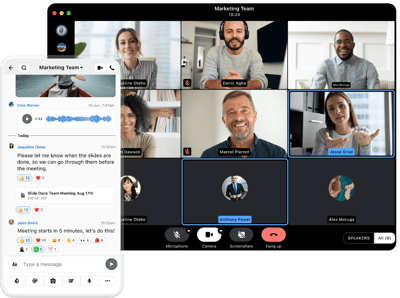
The Wire app provides unified, real-time collaboration platform including messaging, calling, conferencing, and document collaboration. The platform is protected by MLS-powered end-to-end encryption plus enterprise-class SSO and SCIM controls, and seamlessly supports internal and external parties with strong yet easy-to-manage access controls. Combined with mobile-first, consumer-grade ease of use, these capabilities have made Wire the best choice to replace shadow collaboration apps and support sensitive, classified, and crisis communications.
If you're ready to replace shadow collaboration apps, create a secure collaboration segment for your most sensitive workflows, and ensure resilience for crisis communications, look no further.