Modern collaboration software has evolved along two primary architectural paths. On one side are mainstream collaboration platforms that prioritize extensibility and integration but rely on centralized trust models. On the other are secure messaging applications that implement end-to-end encryption (E2EE), typically designed as closed communication systems rather than extensible development platforms.
The Wire Integration SDK represents a third architectural model: a self-contained, managed developer runtime that, in conjunction with the Wire backend, handles encryption, event routing, and storage, freeing developers to focus on collaboration logic rather than cryptographic infrastructure, which is built on emerging IETF standard Messaging Layer Security (MLS), which serves as the foundation of a secure collaboration ecosystem.
Understanding why this change is so important requires examining how SDKs are typically structured across the collaboration landscape.
The Status Quo: How Messaging SDKs Are Normally Built
1. SDKs for Mainstream Collaboration Platforms
Developer ecosystems around mainstream collaboration platforms, such as Slack and Microsoft Teams, are designed around a centralized service architecture.
In these systems, the collaboration platform itself provides:
- Message storage and routing
- Identity and authentication
- Access control
- Workflow engines
- Automation services
- Search and indexing
- Integration frameworks
The SDKs exposed to developers function primarily as integration toolkits that allow external applications to interact with the platform via APIs.
Typical capabilities include:
- Building bots that respond to messages
- Sending or retrieving messages through REST APIs
- Triggering workflows or commands
- Subscribing to platform-generated events
- Creating deleting conversations 1:1 , Group , Channels
- Managing members in Groups and Channel
- React on an event trigger from external source like Jira/Github/Zendesk etc
From an architectural perspective, these SDKs are extensions of a hosted collaboration service, not foundations for building collaboration systems.
The trust model reflects this architecture:
- The platform servers process and store collaboration data
- Encryption is typically limited to transport or server-side encryption
- Automation and integrations operate on the server side
This enables rich integrations but creates a centralized trust boundary where the platform provider ultimately controls the collaboration environment.
2. SDKs for Secure Messaging Applications
Secure messaging systems address the trust limitations of centralized collaboration platforms by implementing end-to-end encryption (E2EE), ensuring that only communicating participants can access message content.
Examples include Signal, Threema, and Element, all built on the Matrix ecosystem.
However, when SDKs are exposed by these systems, they typically function as client libraries for interacting with the messaging network rather than development platforms.
Common characteristics include:
- wrappers around messaging APIs or protocol endpoints
- bindings to existing messaging infrastructure
- client implementations of messaging protocols
- limited extensibility beyond messaging functionality
While encryption is often strong, these SDKs generally assume that developers are building messaging clients or integrations, not new collaboration systems.
As a result:
- Application workflows often remain outside the encrypted domain
- Cryptographic lifecycle management can fall on developers
- Automation and integrations may require trusted servers or gateways
The outcome is that these secure messaging platforms provide secure communication tools, but not necessarily a secure collaboration infrastructure for developers.
The Architectural Gap
Between these two models lies a fundamental gap:
|
Model
|
Developer Role
|
Security Model
|
Ecosystem Capability
|
|
Mainstream collaboration platforms
|
Extend an existing platform
|
Server-trusted
|
Large integration ecosystems
|
|
Secure messaging applications
|
Build messaging clients
|
End-to-end encrypted
|
Limited extensibility
|
|
Wire SDK
|
Build collaboration systems
|
End-to-end encrypted infrastructure
|
Secure collaboration ecosystem
|
The Wire SDK addresses this gap by embedding the core cryptographic and collaboration infrastructure directly into the developer runtime.
The Wire Integrations SDK: A Self-Contained Secure Collaboration Platform for Developers
The Wire Integration SDK fundamentally differs from typical messaging SDKs because it provides the underlying runtime required to build applications that operate inside secure collaboration environments, not just APIs to access one.
At its core, the SDK integrates:
- Standardized group encryption using MLS
- Automated cryptographic lifecycle management
- Identity-aware participation for users and applications
- Event-driven collaboration primitives
Rather than interacting with a messaging service, developers interact with a secure collaboration runtime embedded in their application stack.
Wire Apps (created with the SDK) not only work in isolation within Wire but can also be used to "bridge" Wire and external services. Wire customers and partners can have their own software/automation, anddd the SDK allows events to go externally into Wire conversations, and vice versa.
MLS as the Cryptographic Foundation
A critical enabler of this model is Messaging Layer Security (MLS). MLS was designed specifically to support secure, scalable group messaging with strong cryptographic guarantees, including:
- forward secrecy
- post-compromise security
- efficient group membership updates
- cryptographically verified group state
Implementing MLS correctly requires complex state management involving key trees, group membership changes, and automated rekeying. The Wire Integrations SDK encapsulates this complexity within the runtime. Developers, therefore, interact with secure collaboration primitives rather than cryptographic protocols, while still inheriting the full security guarantees of MLS.
A Secure Collaboration Runtime
Because the SDK manages the full cryptographic lifecycle, it effectively acts as a secure collaboration runtime embedded in applications. Key capabilities include:
Group Lifecycle Management
The SDK automatically manages:
- secure group creation
- participant joins and removals
- cryptographic rekeying
- group state synchronization
Secure Event Model
Applications can subscribe to collaboration events such as:
- encrypted message delivery
- group membership changes
- identity updates
- key rotations
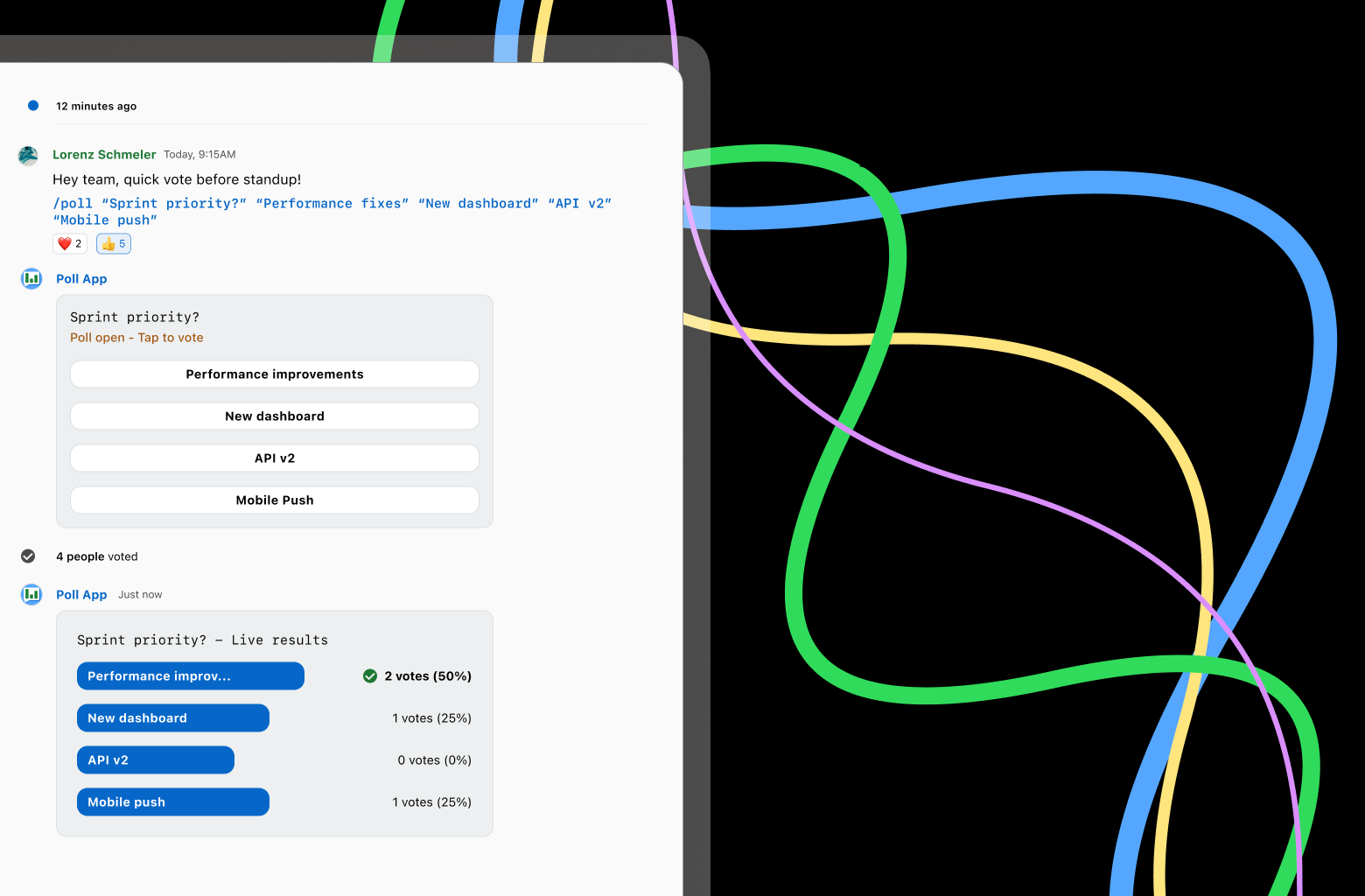
These events enable workflow automation and application logic to operate inside the encrypted collaboration environment. By subscribing to these events, you can trigger your application logic in an automated way. You can learn more about the SDK architecture at dev.wire.com/architecture.
From Messaging SDK to Collaboration Ecosystem
By combining cryptographic infrastructure, identity primitives, and event-driven collaboration logic, the Wire Integrations SDK enables something that typical messaging SDKs cannot: secure collaboration ecosystems.
Multiple applications can interact within the same encrypted environment, including:
- messaging clients
- document collaboration tools
- workflow engines
- automation services
- compliance monitoring systems
- AI assistants
All participants operate within the same MLS-secured collaboration groups, sharing a common trust model enforced by the SDK.
This allows organizations to build ecosystems where collaboration services interact without exposing sensitive data to centralized infrastructure.
A New Developer Model for Secure Collaboration
This architectural approach changes the role of developers. Instead of choosing between:
- extending centralized collaboration platforms, or
- building secure but isolated messaging applications
Developers can now build applications and services that operate natively inside Wire’s secure collaboration environment. The Wire SDK therefore transforms secure messaging from a feature of communication software into a foundational layer for building secure collaborative systems.
See our Wire Integrations SDK support page for more information.