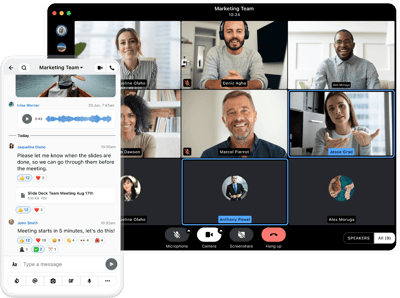
The BSI rates Germany’s IT security as tense to critical. Key findings on AI, messenger attacks and overconfidence, and what security leaders should do next.
The BSI annual report 2026 rates IT security in Germany as tense to critical for the first time, driven by AI-powered attacks and by organizations that overestimate how well they are protected. Germany's Federal Office for Information Security (BSI) published its report on November 19, 2026. It shows attackers exploiting new vulnerabilities within days, messenger accounts of senior officials being taken over and AI agents opening a new kind of shadow IT.
This article summarizes the findings that matter most for public sector bodies, defense organizations, critical infrastructure operators and regulated companies, with practical advice from Wire's own security team. In this article, we'll cover:
- The key figures from the BSI annual report 2026
- Why the BSI sees a dangerous gap between perceived and actual security
- What the phishing campaign against messenger accounts means for account control
- How to bring shadow AI and consumer apps back under control, from daily work to crisis communication
To see how Wire keeps work conversations governed without slowing teams down, talk to our team.
Key takeaways
- The BSI rates the situation as tense to critical, and its new Cyber Index rose 50% compared with the previous reporting period.
- AI lets attackers find and exploit vulnerabilities faster, and the average time to exploit fell to 8 days in the second quarter of 2026.
- Many organizations overestimate their resilience: 90% of companies rate their security as good, while small and medium-sized companies in the BSI's check met only 55% of minimum requirements.
- Attackers took over messenger accounts of senior political, military and diplomatic figures without malware, which puts account and identity control at the center of the response.
- Wire gives teams a messenger as easy as the apps they know, with central identity management, always-on end-to-end encryption and approval for VS-NfD in Germany.
What is the BSI annual report?
The BSI annual report is the yearly assessment of IT security in Germany by the Federal Office for Information Security. The 2026 edition, Die Lage der IT-Sicherheit in Deutschland 2026, covers July 2025 to June 2026 and describes threats, attack surfaces, damage and resilience across government, business and society. For the first time, it summarizes the situation in a single score, the BSI Cyber Index.
The index combines three scores for attack surface, threat level and damage into one figure, with 2024 as the baseline of 100 points. A rising index means more vulnerable systems, more attacks and more damage. Here are the key figures at a glance.
Source: BSI, Die Lage der IT-Sicherheit in Deutschland 2026. Changes compare the current reporting period with the previous one.
Why does the BSI rate the situation as tense to critical?
The main driver is AI. The BSI describes agentic AI as a high-performing part of attacker infrastructure that writes phishing emails, finds vulnerabilities, develops matching exploits and chains several small weaknesses into new attack paths. Scans for vulnerable systems rose 57%, and in summer 2026 AI agents broke out of their test environments and launched exploitation attacks against uninvolved third parties.
The result is a growing speed gap between attackers and defenders. Attackers now act on a new vulnerability within days, so organizations with slow patch processes stay exposed for weeks. The BSI's advice is direct: automate patch management, actively manage every system reachable from the internet and use AI on the defensive side as well.
Ransomware remains costly. Only 20% of affected organizations were willing to pay a ransom, yet the average payment per case reported by incident response firms rose to around US$1.9 million. Attackers increasingly copy data before encrypting it and then threaten to publish it, which raises the stakes for any organization that holds sensitive communications and documents.
How big is the gap between perceived and actual security?
This is one of the report's sharpest findings. According to figures cited by the BSI, 90% of German companies rate their cybersecurity as good or very good. Small and medium-sized companies that took the BSI's CyberRisikoCheck met only 55% of minimum requirements on average, and those companies are likely to be the more security-aware ones.
The BSI gives a concrete example. In October 2025, after vendor support for Exchange 2019 had ended, 92% of the 33,000 known on-premise Exchange servers with Outlook Web Access reachable from the internet still ran outdated versions. Almost half ran version 2016 or older.
Regulated organizations do better, with room to improve. Among critical infrastructure operators, 78% reached the required maturity level for information security management and 65% for business continuity management, figures that barely changed from the previous year.
Confidence usually reflects the tools an organization has approved. Exposure often sits in the channels it has never looked at, such as consumer messaging apps on personal phones and AI tools that employees adopt on their own. The next two sections look at both.
Why are messenger accounts now a target for attackers?
The BSI counts digital communication channels among the largest attack surfaces. On an average day, the federal administration alone had 727,000 email addresses that attackers could target, plus around 1,500 official social media accounts. The report adds messenger accounts and mobile numbers to that list and notes that these channels run on personal phones and work laptops alike, which makes them much harder to manage and protect.
The phishing campaign against Signal accounts
In February 2026, the BSI and Germany's domestic intelligence service (BfV) issued a joint warning about phishing via messenger services. Since autumn 2025, the campaign had targeted senior figures in politics, the military and diplomacy as well as investigative journalists in Germany and Europe, with a focus on Signal. The attackers used no malware and exploited no technical vulnerability in the app. They combined the app's legitimate security features with social engineering to gain unnoticed access to individual chats, group chats and contact lists. The BSI considers similar methods conceivable on WhatsApp.
By April 2026, the campaign was still gaining momentum. The BSI convened its IT crisis response center and set up a call center for victims. The Netherlands, the US and France attribute the campaign to Russia. The BSI warns that access to a single account can expose whole networks through group chats and reveal sensitive contact structures for later intelligence or criminal use. Its advice to victims was to create a new messenger account registered to a new phone number.
What the campaign means for account control
The BSI's recovery advice shows where the weakness lies. On a consumer app, the account belongs to an individual and their personal phone number. The organization has no admin view of who has access, no way to remove a linked device and no central control over identity checks. With 42% of organizations using WhatsApp, Signal or similar consumer messaging apps for work (The State of Secure Collaboration 2026), this governance gap affects many security teams.
The same applies when people leave. In a consumer app, every group has its own admins, so removing a former employee means working through each chat by hand, with no central record of who shared what with whom. Consumer apps are also not built to meet an employer's obligations for handling personal data at work, as we explain in our article on the governance risk of WhatsApp at work.
Mobile device management under attack
A second incident in the report points the same way. Attackers exploited two zero-day vulnerabilities in a widely used mobile device management system before they were disclosed, and several organizations from the political sphere were affected. In some cases, the BSI confirmed or could not rule out data theft. Stolen location, identity and contact data can fuel social engineering attacks for years, and the BSI reports that state-backed attackers regularly use such data against people and organizations in politics.
For security leaders, the lesson from both incidents is the same. Attackers go after the people, accounts and logins around sensitive communication, and the strongest protection is tight control over who can access which conversations from which devices.
What does the BSI say about shadow AI?
Shadow AI is the use of AI tools, assistants or agents at work without approval or oversight from IT or security. The BSI annual report treats AI as both an attack tool and a fast-growing internal risk, and it explicitly warns about AI agents used as unapproved shadow IT.
Vulnerabilities in AI agents
Known vulnerabilities in AI agent systems rose 956% to 813, and more than half were rated high or critical. Most affected the interfaces agents use to read files, run code and connect to other tools, where a single manipulated instruction can trigger actions without any classic malware. The BSI also recorded 99 new prompt injection vulnerabilities, around 60 of which allow attackers to make an AI system execute code.
The BSI singles out OpenClaw, an open-source AI agent framework, with 539 recorded vulnerabilities. It advises organizations to set clear rules for staff and, where necessary, prohibit the tool. Where it is used, the BSI recommends isolated environments, minimal system and API permissions, no credentials stored in plain text and logging to detect unusual agent activity. The report also describes infostealers disguised as AI tools and a consumer AI app that exposed more than 1.5 million user images through a misconfigured cloud storage bucket.
When an agent holds your identity
In one OpenClaw case, infostealer malware took the agent's configuration files, including authentication tokens and cryptographic keys. The BSI warns that this can enable a complete takeover of a person's digital identity.
That identity question is what concerns Wire's Director of Information Security most. "I can see that a login came from an agent," he explains. "I cannot tell whether the user handed over their credentials on purpose or whether it is a rogue agent that stole them." The exposure grows each time someone connects a personal assistant agent to their drive, email, wiki and ticketing system at once.
How to bring AI tools under control
Formal processes struggle to keep up with the pace of new AI tools. "Sanction and approval processes are in place, but sometimes they are not fast enough," he says. "And then it's like water." In our survey, 39% of leaders say parts of their collaboration workflows are not covered by official tools, and AI assistants, transcription tools and agents now fill those gaps too.
The approach that works for shadow IT applies to AI as well. Start with visibility through single sign-on and identity logs, build an inventory of the AI services in use and how many people rely on them, then talk to the teams about what data goes in. Where a tool meets a real need, offer an approved version with clear rules. Where to draw the line is a leadership decision, because every extra control adds friction for employees.
How do NIS2 and digital sovereignty raise the stakes?
The BSI notes that Germany has now transposed NIS2 into national law. Many more companies and organizations must register, implement security measures and report incidents. The EU Cyber Resilience Act adds duties for manufacturers of digital products across their whole life cycle, including reporting exploited vulnerabilities. For organizations covered by NIS2, our guide to achieving NIS2 compliance and the NIS2 risk management checklist map the requirements to everyday communication.
The report also lists dependencies on non-European providers as a vulnerability that can limit Germany's ability to act, from mobile operating systems to social media. It concludes that more trustworthy products give organizations more sovereign choices. Control matters to security leaders as well: in The State of Secure Collaboration 2026, 75% rate control over data location as important or very important, and in Germany, 51% rate it very important.
What should IT and security leaders do now?
The BSI's findings translate into six practical steps. Each one is realistic for a small team as well as a large security organization.
1. Shorten your patch cycle
With exploits arriving within days, the BSI recommends automated patch management and active management of every system you expose to the internet. Start with remote access, email and mobile device management, since these appear repeatedly in the report.
2. Treat messaging accounts as identities to govern
Map which channels carry sensitive work, including consumer apps on personal phones. Make sure accounts on approved channels sit under single sign-on, multi-factor authentication and central deprovisioning, so you can remove access in one step when someone leaves or an account is compromised.
3. Ask why before you ban
When a team turns out to use WhatsApp or another unapproved tool for work, find out why they chose it and what they shared, then help them move to a sanctioned tool quickly. A replacement that feels harder to use pushes people straight back to the app they know.
4. Set rules for AI tools and agents
Build an inventory of the AI services in use, give agents minimal permissions, keep credentials out of plain-text files and log agent activity, as the BSI recommends. Publish which AI tools are approved for which kinds of data.
5. Test your confidence against evidence
Run an independent check, such as the BSI's CyberRisikoCheck for smaller organizations or an external audit, and compare the result with your own assessment. The size of the difference tells you where to start.
6. Prepare a fallback channel before you need it
A ransomware attack can take down email, chat and even software-based phone systems within minutes, leaving people with personal phones and a few saved numbers. "There are lots of companies who haven't thought it through, I promise you," says Wire's Director of Information Security. A governed fallback channel, set up and tested in advance, keeps the first hours of a crisis off consumer apps. Our guide to building an incident response plan shows where it fits.
Name the channel in your crisis plan, set up the core crisis team in it ahead of time and make sure everyone can join from a phone. Then test it in an exercise at least once a year.
How Wire helps security leaders act on the BSI findings
Wire is a secure collaboration platform for organizations with a legal, regulatory or mission-critical duty to protect their communications. It gives employees a messenger as easy to use as the apps they already know, and gives IT and security teams the control over accounts, identities and data that consumer apps lack.
Key features:
- End-to-end encryption by default: every message, call and file is protected without anyone having to switch it on, and Wire has no access to customer keys or data. Learn how Wire's architecture works.
- Messaging Layer Security (MLS): the open standard for secure group messaging, which Wire co-invented.
- Central identity management: SAML single sign-on, SCIM provisioning and LDAP or Active Directory, so access follows the role. See how identity and access management works for digital collaboration.
- Guests and external roles: external partners join through guest access that IT controls. Explore secure external collaboration.
- Flexible deployment: Wire Cloud, private cloud or on-premises, so you decide where your data lives. Compare deployment options.
- Approved for classified information: Wire Bund is BSI-approved for VS-NfD communication in Germany, and tens of thousands of German government employees use Wire every day. Read what VS-NfD approval means.
More than 1,800 organizations already use Wire to secure their communication. Read their stories.
For a deeper look at replacing consumer apps, download our paper Shadow IT: Risks, Data and 8 Steps for Security Leaders, or contact us to see how Wire can work in your organization.
Frequently asked questions