In many enterprises, communication is fragmented across multiple tools. Employees move between email, Microsoft Teams or Slack, WhatsApp groups, video conferencing platforms, file-sharing applications, and in some cases even legacy phone systems just to complete everyday work. Usually, because no single tool provides secure communication across multiple formats.
Are you evaluating enterprise messaging platforms for your organization? If so, there's a good chance your shortlist includes tools like Slack or Microsoft Teams because of their ease of use and widespread adoption.
But these features tell you very little about how well the platform protects sensitive communication. Employees often end up using these platforms to share confidential documents, discuss sensitive information, coordinate incident response efforts, and communicate with external partners.
For security and compliance teams, that raises an important question: who can access those conversations?
Many platforms claim to be secure, but not all provide end-to-end encryption. Some allow administrators to access message content, while others make trade-offs around sovereignty, external collaboration, or deployment flexibility.
In this guide, we'll explain what to look for in an enterprise communication tool, how leading solutions compare, and what security-conscious organizations should consider before making a decision.
If security and ease-of-use are both important for you, take a look at how Wire makes every message, call, and file E2EE by default without compromising on the user interface. Book a demo with our team.
Key takeaways
-
Most enterprise messaging platforms offer similar collaboration features. The real differences come down to how they manage security architecture, administrative access, deployment flexibility, and governance controls.
-
Apart from E2EE, organizations should evaluate who controls encryption keys, whether administrators can access message content, and how the platform responds to security incidents.
-
Employee adoption is also crucial because when approved communication tools are difficult to use, employees often turn to consumer apps such as WhatsApp, creating shadow IT and compliance risks.
-
Industries handling sensitive information (government, defense, financial services, legal, and critical infrastructure organizations) require stronger protections around privacy, sovereignty, and operational resilience than traditional collaboration platforms typically provide.
-
Wire helps organizations secure messages, files, calls, and conferences without sacrificing usability, giving security teams stronger control while keeping employees on approved communication channels.
What is an enterprise messaging platform?
An enterprise messaging platform is a software solution that enables real-time communication, file sharing, voice and video collaboration, and team coordination across an organization. Unlike consumer messaging apps (WhatsApp, iMessage, Telegram), it includes centralized administration, compliance controls, identity management, and security features such as end-to-end encryption (E2EE) to protect business communications.
Most enterprise messaging platforms on the market today provide the same set of features like channels, direct messages, group conversations, file sharing, search, voice calls, and video meetings. So simply comparing these features isn’t really helpful.
What’s more important for IT, security teams, and compliance officers is whether the platform is secure, compliant, supports data sovereignty, and addresses operational risk. They want to know:
- Is E2EE applied to every message, file, and call?
- Who controls the encryption keys?
- Can the vendor access communication content?
- Can internal administrators read employee messages?
- Does the platform support sovereign, private cloud, or on-premises deployment?
- Can security controls be enforced consistently across the organization?
While many vendors market their platforms as secure, the underlying architecture ultimately determines who can access your communications and how well the platform can support compliance, sovereignty, and risk management requirements.
The problem with most enterprise messaging platforms
Most enterprise messaging software claim to be secure because they encrypt data in transit and at rest. However, encryption alone doesn’t guarantee privacy. In many cases, the vendor and authorized administrators can still access message content, creating direct compliance consequences for organizations handling sensitive communications.
Encryption alone does not guarantee message privacy
Nearly every enterprise messaging software vendor promotes encryption as a core security feature. The challenge is that encryption can mean very different things depending on how the platform is designed. Here are two ways for software to offer encryption:
- Transport encryption (TLS combined with AES-256 at rest): TLS protects messages while they travel between a user's device and the vendor's servers. Once those messages reach the server, they are decrypted for processing, storage, indexing, and compliance functions. At that point, the platform provider can technically access message content, and so can any authorized administrators.
- End-to-end encryption (E2EE): Messages are encrypted on the sender's device and can only be decrypted on the recipient's device. The platform's infrastructure simply transports encrypted data without access to the content itself.
Most enterprise team messaging tools offer the first one. Slack, for example, encrypts messages in transit and at rest, but the platform itself is not E2EE. That means Slack and Slack administrators can access message content.
Similarly, Microsoft Teams supports E2EE only for 1:1 calls, and only as an opt-in setting that requires both parties to manually enable it. Standard Teams messages, group calls, and channel content are not E2EE, and Microsoft's infrastructure retains access to that content.
Many communication tools are also increasingly using AI on their platforms, but it ultimately breaks down encryption to function properly. Plus, platforms that do offer E2EE often do it at the expense of other basic features, like restricting the ability to send messages during calls.
Opt-in E2EE fails at enterprise scale
Some vendors, like MS Teams, offer end-to-end encryption as an optional setting. While this sounds like a reasonable feature, it creates a governance problem that security teams shouldn’t overlook.
When encryption depends on individual users enabling a setting, security becomes inconsistent. One team may follow policy correctly, while another may forget to activate the required protections. Or, even if you enable it, the other person can break it easily by not turning on the encryption setting.
In large organizations, the probability of a team member not enabling E2EE increases significantly, and even a single unprotected conversation can create compliance exposure, audit findings, or unnecessary operational risk.
Security controls are most effective when they are enforced consistently across the organization rather than relying on user behavior.
Wire is an enterprise messaging platform that applies E2EE by default to every message, file, call, and conference. Security is built into the architecture itself. Through Operator Shield, even Wire's own administrators can’t access your message content, eliminating one of the most common trust gaps found in enterprise collaboration platforms.
Shadow IT & why employees turn to unapproved messaging apps
At the end of the day, most teams simply want a platform that’s easy to use while being secure. But when employees feel that approved communication tools are slow, difficult to use, or unavailable on the devices they rely on every day, they default to WhatsApp, Telegram, or personal Signal accounts for work conversations.
Of course, this creates fragmented communication records, limited visibility for compliance teams, and increased risk of data loss or unauthorized disclosure.
Blocking consumer apps rarely solves the problem on its own. Employees need a platform that delivers the same ease of use and accessibility they expect from consumer tools while meeting enterprise security and compliance requirements.
The most effective enterprise team messaging platforms combine strong governance with a user experience that encourages adoption. When security is frictionless and collaboration feels natural, employees are far more likely to stay within approved communication channels, reducing both compliance risk and operational blind spots.
Check out how Wire provides an easy-to-use, secure collaboration platform.
Also read: Telegram is a popular consumer alternative because it's often advertised as a secure platform. But it doesn't offer E2EE by default, and recent reports reveal major privacy flaws in it. Learn more at: Telegram: A Security or Surveillance Tool?
What to look for in an enterprise messaging platform
Choosing an enterprise communication solution is no longer about comparing channels, file sharing, or video conferencing features. Most leading platforms offer similar collaboration capabilities. The real differentiators are security architecture, governance controls, deployment flexibility, and the platform's ability to support compliance requirements without creating operational friction.
The following criteria can help security and IT leaders separate platforms that simply offer collaboration features from those designed for secure enterprise communication at scale, like Wire.
End-to-end encryption by default (Not opt-in)
End-to-end encryption should be a baseline requirement for a secure enterprise messaging tool.
When evaluating vendors, ask whether E2EE is applied automatically across all communication types, including messages, files, voice calls, video meetings, and screen sharing. If employees or administrators must manually enable encryption, the organization ends up relying on user behavior to enforce security.
It is equally important to understand who can access communication content. Ask:
- Can the vendor access message content?
- Can internal administrators read employee conversations?
- Are encryption keys controlled exclusively by end users?
If the answer to any of these questions is yes, the platform is operating on a trust-based security model rather than a zero-knowledge architecture.
Wire offers E2EE enterprise messaging to every message, file, and call by default. Operator Shield enforces this protection at the architectural level, ensuring that neither Wire nor customer administrators can access your message content.
Messaging Layer Security (MLS)
One of the biggest challenges in enterprise messaging is applying E2EE to large groups. Encrypting a one-to-one conversation is relatively straightforward. But encrypting a conversation involving hundreds of participants is far more complex.
Every time someone joins a channel, leaves a project, changes devices, or loses access, encryption keys must be updated without exposing previous communications or disrupting the user experience. This is one reason many enterprise messaging platforms either avoid E2EE enterprise messaging altogether or limit it to specific use cases such as 1:1 calls.
Messaging Layer Security (MLS) was developed by the Internet Engineering Task Force (IETF) to solve this problem. The protocol enables E2EE for large-scale group communication.
When evaluating an enterprise messaging platform, ask how it delivers E2EE for group messaging, file sharing, and conferencing. If E2EE is limited to specific features or small groups, the platform may struggle to provide consistent protection across the organization.
Wire co-founded the MLS standard and was the first enterprise messaging platform to implement it across messaging, file sharing, voice calls, video conferencing, and collaboration workflows. As a result, every conversation is equally secured, whether it involves two people or an entire organization.
Post-compromise security & perfect forward secrecy
Simply considering a platform’s ability to prevent breaches is not enough. You should also evaluate how well it limits the damage when a device, account, or encryption key is compromised.
Look for two things in an enterprise messaging app:
- Perfect Forward Secrecy: Prevents previously exchanged messages from being decrypted even if a current encryption key is compromised.
- Post-Compromise Security: Automatically restores protection for future communications once a compromised device regains trust.
For organizations handling sensitive information, these safeguards help contain the impact of security incidents and support faster recovery. Wire delivers both through its MLS-based architecture, providing stronger protection before, during, and after a compromise.
Learn more about how Wire handles crisis communication.
Sovereign & on-premises deployment
Enterprise messaging for government, defense, critical infrastructure, healthcare, and financial services needs to account for data residency requirements, national regulations, and internal governance policies that often dictate where communication systems can be deployed and managed.
Before selecting an enterprise messaging app, determine whether it supports:
- Public cloud deployment: Hosted on shared infrastructure managed by a cloud provider.
- Private cloud deployment: Runs on dedicated infrastructure for a single organization.
- On-premises deployment: Installed and operated within an organization's own data centers, allowing full ownership of systems and data.
- Air-gapped environments: Completely isolated from external networks to prevent unauthorized access and enhance security.
- Regional data residency requirements: Ensure data is stored and processed within specific geographic regions to comply with local regulations.
Wire supports all these deployment options, giving organizations full control over how and where communications are hosted.
Identity integration (SSO, SCIM & device verification)
In any organization, employees join teams, change roles, leave the organization, and switch devices constantly. If access controls are not tightly connected to your identity infrastructure, it becomes difficult to know who can access sensitive conversations and whether they should still have access at all.
That is why enterprise messaging platforms should integrate directly with existing identity providers. Single Sign-On (SSO) and System for Cross-domain Identity Management (SCIM) help automate onboarding and offboarding, ensuring access is granted and removed consistently across the organization rather than relying on manual administration.
Focusing on how a platform handles device trust is equally important. Security teams need confidence that the device accessing sensitive communications is known, trusted, and compliant with security policies.
Wire's ID Shield extends identity verification beyond user accounts by validating trusted devices through existing Identity Providers. This helps organizations strengthen security without adding complexity for employees.
Secure federation for external messaging
Many messaging platforms handle external messaging by requiring external users to join your environment or by moving conversations into less secure channels, such as email and consumer messaging apps. Both approaches create governance and security challenges.
Secure federation allows separate organizations to communicate directly while each retains control over its own users, policies, and data. Instead of extending trust to another organization's environment, both sides maintain independent administration without sacrificing usability.
When evaluating platforms, ask:
- Can external organizations communicate securely without joining your tenant?
- Does each organization maintain independent governance and administration?
- Is communication protected by the same security controls used internally?
- Can administrators control which organizations are allowed to federate?
- Can the platform restrict directory search and user discovery to prevent unauthorized users from being found?
Wire's federation model enables secure communication between independent Wire environments while preserving administrative separation, governance policies, and E2EE.
Wire Pro Tip
Don't evaluate these capabilities in isolation. Many platforms offer one or two of the features we discussed, but very few combine always-on E2EE, MLS, secure federation, identity-based device trust, and sovereign deployment options in a single platform. See how Wire brings them together to deliver secure communication at enterprise scale.
Book a demo today.
Enterprise Messaging Platform Comparison
On the surface, most enterprise messaging tools offer the same features, such as team chat, file sharing, voice and video meetings, mobile apps, and integrations with business systems.
But for security teams, head of IT, and CIOs, what matters is security architecture, administrative access, deployment flexibility, and encryption design, along with ease of use. Here’s a comparison of some of the most common messaging platforms, focusing on how truly secure they are.
| Feature / Criterion |
Wire |
MS Teams |
Slack |
Mattermost |
| E2EE by default — all features |
✓ |
⚠
1:1 opt-in only |
✗ |
✗ |
| MLS protocol |
✓ |
✗ |
✗ |
✗ |
| E2EE group messaging |
✓ |
✗ |
✗ |
✗ |
| E2EE file sharing |
✓ |
✗ |
✗ |
✗ |
| E2EE voice & video (group) |
✓ |
✗ |
✗ |
⚠
Plugin needed |
| Zero trust architecture |
✓ |
⚠
Partial |
✗ |
⚠
Partial |
| Admin cannot read messages |
✓ Operator Shield |
✗ |
✗ |
✗ |
| Local encryption key storage |
✓ |
✗ |
✗ |
✗ |
| Open source / auditable |
✓ |
✗ |
✗ |
✓ |
| On-prem / sovereign deployment |
✓ |
⚠
Limited |
✗ |
✓ |
| Secure federation |
✓ |
⚠
Limited |
✗ |
✗ |
| SSO + SCIM provisioning |
✓ |
✓ |
✓ |
⚠
Limited |
| Approved for classified comms by the German government |
✓ Wire Bund |
✗ |
✗ |
✗ |
| EU-headquartered & EU-hosted default |
✓ |
✗ |
✗ |
✗ |
✓ Supported by default ⚠ Limited or opt-in ✗ Not supported
Based on the features we listed and the table, here’s a quick overview to help you choose the right platform.
- Slack: This is one of the most widely adopted enterprise messaging platforms because of its user experience and ecosystem. However, it doesn’t provide E2EE for internal or external messaging, files, or calls. Plus, you can’t choose the kind of deployment you want, and it isn’t EU-hosted, which doesn’t make it safe for government, defense, or security-focused teams.
- Microsoft Teams: Often the default choice for organizations already invested in Microsoft 365. While it offers extensive collaboration capabilities, E2EE is limited to specific 1:1 calling and is not applied consistently across messaging, file sharing, and group collaboration workflows.
- Mattermost: Appeals to organizations seeking self-hosting and greater infrastructure control. However, self-hosting alone does not guarantee privacy. Without native E2EE across communications, administrators and infrastructure operators can access your content.
As you can see, Wire is the only platform that combines always-on E2EE, protection from administrator access, secure federation, and flexible deployment options within a single security architecture, all the while maintaining ease-of-use.
For teams evaluating alternatives to Slack or Microsoft Teams, that combination can reduce security risk without creating the adoption challenges that often accompany enterprise security tools.
For a detailed comparison, check out:
Or, see how Wire can help your team communicate securely. Get in touch.
Which industries need a security-first messaging platform?
While platforms such as Slack and Microsoft Teams may be sufficient for some organizations, others require stronger controls around encryption, deployment, governance, and data sovereignty.
The more sensitive the information being shared, the more important it becomes to understand who can access communications, where data is stored, and how security policies are enforced. Here are some industries where it is crucial to choose security-first enterprise messaging software like Wire.
Government & defense
Government agencies, defense organizations, and national security teams often handle information that can’t be exposed to vendors, third-party administrators, or foreign jurisdictions.
These organizations typically require:
- End-to-end encryption by default
- Sovereign or on-premises deployment
- Secure communication with external agencies
- Strong identity and device controls
For these environments, security architecture and operational control are the primary procurement criteria.
Wire Bund is approved for VS-NfD communications by Germany's Federal Office for Information Security (BSI), the German government standard equivalent to NATO RESTRICTED, making it suitable for some of the most demanding government communication requirements.
Learn more about Wire’s government use case.
Financial services
Banks, insurers, investment firms, and other financial institutions operate in one of the most heavily regulated environments in the world. Communication platforms are expected to support compliance requirements around data protection, operational resilience, governance, and auditability.
Regulations such as MiFID II and the Digital Operational Resilience Act (DORA) place increasing scrutiny on how organizations manage business communications. Many firms also have internal security and compliance requirements that go beyond regulatory minimums, particularly for executive communications, M&A activity, client information, and incident response.
As a result, financial institutions need actual evidence that:
- Sensitive communications are protected by design
- Administrators can’t access confidential discussions
- Deployment and data residency options align with their risk management policies
Wire's zero-knowledge architecture helps address these requirements by ensuring that no third party (including Wire itself) can access message content. Combined with E2EE, strong identity controls, and flexible deployment options, this provides a foundation for secure communication in highly regulated environments.
Legal & professional services
For law firms, consultancies, accounting firms, and advisory businesses, confidentiality is a core part of the service they deliver. If a vendor or administrator can access client communications, that creates additional risk around privileged and confidential information.
Wire addresses this challenge through Operator Shield, which prevents administrators from accessing message content. Its open-source architecture also allows security teams to independently verify how these protections are implemented, providing a higher level of transparency than closed-source collaboration platforms.
Critical infrastructure & crisis response
One of the first questions during a cyber or ransomware attack is whether your communication tools can still be trusted. In these situations, teams need a communication platform that remains accessible, secure, and independent from the systems under investigation.
Wire is designed for this scenario. Whenever there is a crisis, security teams can quickly quarantine affected accounts, revoke trusted devices, and limit the spread of a compromise without disrupting the rest of the organization. At the same time, E2EE messaging, calling, and conferencing provide a trusted channel for coordinating incident response across internal teams and external stakeholders.
This combination of secure communication and rapid recovery capabilities helps organizations maintain operational continuity when their primary systems are under attack.
The shadow IT problem: Why employees turn to WhatsApp
We discussed in the comparison section earlier how important ease-of-use is when evaluating vendors. That’s because you can choose any platform you prefer, but when collaboration tools feel slow, complicated, or disconnected from how people communicate every day, employees often turn to consumer apps instead.
WhatsApp is one of the most common sources of shadow IT in enterprise communication. Employees use it because it is fast, familiar, mobile-first, and available on every device they own. Some even think WhatsApp is fully encrypted, because it’s often advertised as such.
The problem is that business conversations taking place on WhatsApp sit outside enterprise governance. This creates several gaps:
- No centralized admin controls
- No SSO integration
- No SCIM provisioning
- Limited compliance oversight
- Its AI agent breaks down encryption
- Little control over how sensitive information is shared externally
Many organizations try to solve this problem by banning WhatsApp. In practice, that rarely works because when approved communication tools are difficult to use, employees simply find alternative channels.
The only effective solution is to provide a platform that employees genuinely prefer to use while giving security and compliance teams the controls they need.
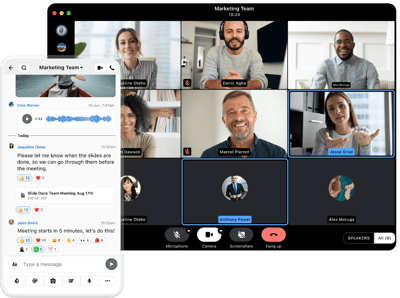
Wire delivers the experience users expect from intuitive messaging apps, including mobile and desktop applications, voice notes, reactions, self-deleting messages, real-time location sharing, and seamless communication across iOS, Android, web, and desktop, with support for using up to 8 devices simultaneously.
At the same time, organizations gain always-on E2EE, SSO, and SCIM integration, centralized administration, and enterprise-grade governance. Guest links allow external partners and contractors to join secure conversations without creating a Wire account, eliminating one of the main reasons employees create unmanaged WhatsApp groups.
Check out the best WhatsApp alternatives for businesses.
Why security-first organizations choose Wire
Most enterprise messaging platforms force organizations to compromise somewhere. They may offer strong collaboration features but leave message content accessible to vendors or administrators. Others prioritize privacy but create usability, governance, or deployment challenges that make adoption difficult.
Wire was built to eliminate those compromises by combining enterprise usability, strong governance, and verifiable security in a single platform.
Some of its key capabilities include:
- Always-on end-to-end encryption: Every message, file, call, and conference is protected by E2EE by default. Your team doesn’t have to manually select this feature as it’s built into the platform itself.
- Operator Shield: Most enterprise communication tools require users to trust that administrators will not access sensitive conversations. Operator Shield removes administrators from the trust model entirely, ensuring that even Wire's own system administrators cannot read message content.
- MLS-based security: Wire co-founded the Messaging Layer Security (MLS) standard and was the first enterprise messaging platform to implement it across messaging, file sharing, calling, and conferencing. MLS provides post-compromise security and forward secrecy at enterprise scale.
- Sovereign deployment options: Wire can be deployed in the public cloud, private cloud, on-premises, or fully air-gapped environments, giving teams control over where communication data resides and how it is managed. It is also EU-headquartered and hosted in the EU by default to help you maintain sovereignty.
- Compliance-ready architecture: Security teams are increasingly expected to prove that communication systems meet regulatory and internal governance requirements. Wire supports ISO 27001 and ISO 27701, along with Cyber Essentials, which is the UK government-backed baseline certification, while Wire Bund is BSI-approved for VS-NfD communications.
- One secure workspace: Messaging, voice and video conferencing, and Wire Drive file sharing operate under the same security model, eliminating the need for multiple disconnected tools.
More than 1,800 organizations trust Wire for secure collaboration, helping us maintain a 95% customer retention rate. Read our case studies here.
If your organization is evaluating Slack, Microsoft Teams, Mattermost, or other enterprise messaging platforms, request a personalized demo to see how Wire delivers security, sovereignty, and usability without compromise.
| |
|
|
|
|
| |
|
|
|
|
| MLS protocol |
✓ |
✗ |
✗ |
✗ |
| Zero trust architecture |
✓ |
⚠ Partial |
✗ |
✗ |
| Local encryption key storage |
✓ |
✗ |
✗ |
✓ |
| On-prem / sovereign deployment |
✓ |
⚠ Limited |
✗ |
✗ |
| Secure federation |
✓ |
⚠ Limited |
✗ |
✗ |
| SSO + SCIM provisioning |
✓ |
✓ |
✓ |
✗ |
| E2EE file sharing |
✓ |
✗ |
✗ |
⚠ Limited |
| E2EE group conferencing |
✓ |
✗ |
✗ |
⚠ Up to 75 |
| Open source / auditable |
✓ |
✗ |
✗ |
✓ |
| Approved for classified comms by the German government |
Wire Bund |
✗ |
✗ |
✗ |
| Enterprise governance and auditability |
✓ |
✓ |
⚠ Partial |
✗ |
✓ Supported by default ⚠ Limited or opt-in ✗ Not supported
Beyond its security credentials, Wire is designed for everyday usability, helping organizations reduce shadow IT and drive adoption without sacrificing productivity.
This combination of enterprise-grade protection and a user-friendly experience is what gives Wire a 95% customer retention rate, showing that you do not have to choose between strong security and effective collaboration.
Book a demo to see Wire in action and explore the deployment options, security controls, and collaboration features that fit your organization's needs.
Frequently asked questions