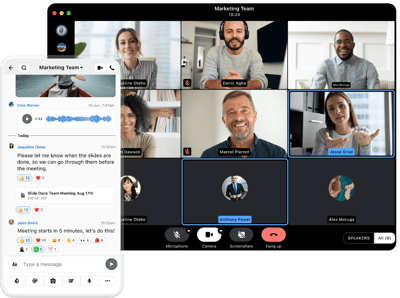
Enterprises are rethinking their communication infrastructure due to growing concerns about vendor lock-in, US cloud jurisdiction, cyberattacks targeting collaboration systems, stricter compliance requirements, and growing pressure around AI and data governance.
Open source communication platforms have become part of the solution because they offer greater visibility, deployment control, and infrastructure independence.
In this article, we'll discuss some of the top open source communication platforms you can choose from, the benefits of shifting towards an open communication platform, and which questions to keep in mind at your next vendor demo.
But first, see how Wire combines open source transparency with enterprise-grade secure collaboration.
Key takeaways
- Open source communication platforms give enterprises more control over deployment, infrastructure, and data governance than closed SaaS collaboration tools.
- Open source and self-hosting alone don't guarantee security. Encryption architecture, governance controls, metadata protection, and operational management still determine whether a platform is enterprise-ready.
- Platforms such as Mattermost, Zulip, and Rocket.Chat are strong options for developer collaboration, async communication, and customization-heavy deployments.
- Element/Matrix, Nextcloud Talk, Jitsi, Twake, Prosody/Ejabberd, and IRC each support different use cases ranging from federation and video conferencing to lightweight messaging and custom infrastructure.
- Wire combines open source transparency with enterprise-grade security, sovereign deployment flexibility, secure external collaboration, and governance controls built for regulated environments.
What is an open source communication platform?
An open-source communication platform is software for team messaging, file sharing, voice or video calls, and conferencing whose source code is publicly available for anyone to inspect, audit, and customize.
Unlike proprietary apps (e.g., Slack, WhatsApp, Zoom), an open source communication platform gives you full ownership of data and infrastructure. These platforms support self-hosting, meaning organizations can deploy on their own infrastructure rather than relying on a vendor's cloud.
Some of the common capabilities across open source communication platforms include:
-
Team and direct messaging
-
Voice and video calling
-
Group conferencing
-
File sharing and document collaboration
-
External guest access for cross-organizational communication
-
Integrations with enterprise toolchains and identity providers
Open source platforms expose the underlying codebase for public review, allowing security teams to inspect encryption implementations, evaluate authentication mechanisms, and verify whether the platform aligns with internal governance requirements.
This level of transparency is one of the key differences between open source and proprietary collaboration platforms.
Open source platform vs proprietary platforms
| Area |
Open Source Communication Platforms |
Proprietary Collaboration Platforms |
| Code transparency |
Source code available for inspection and audit |
Closed source; internal implementation hidden |
| Deployment control |
Self-hosted, private cloud, hybrid, or air-gapped options |
Typically cloud-only or vendor-controlled hosting |
| Vendor independence |
Organizations can migrate, customize, or fork platforms |
High vendor dependency and ecosystem lock-in |
| Security verification |
Independent researchers can audit encryption and architecture |
Security claims depend primarily on vendor trust |
| Customization |
APIs, modular architecture, and extensibility |
Customization limited to vendor roadmap |
| Jurisdictional control |
Organizations choose a hosting region and infrastructure |
Data governance tied to vendor infrastructure |
While open source platforms offer things like code transparency and jurisdictional control, that doesn't mean they are automatically secure, private or enterprise-ready. Many still rely on optional encryption, expose metadata, require complex configuration, or lack governance features such as Single Sign-On (SSO), System for Cross-domain Identity Management (SCIM), audit logging, and retention controls.
The architecture and operational model are what ultimately determine whether a platform can support secure enterprise collaboration at scale or not.
Key definitions related to secure open source communication tools
| Term |
Definition |
| Self-hosted |
A deployment model where the organization runs the platform on its own infrastructure rather than a vendor-managed cloud. |
| Federation |
Secure communication between independently operated platform instances. |
| Decentralized communication |
A communication model without a single central server or point of control. |
| End-to-end encryption (E2EE) |
Encryption where only the sender and intended recipients can decrypt the communication content. |
| Sovereign collaboration |
Communication infrastructure hosted and governed within a specific legal jurisdiction. |
| Open standards |
Public protocols such as Matrix, XMPP, and MLS that support interoperability and transparency. |
| Messaging Layer Security (MLS) |
An Internet Engineering Task Force (IETF) standard for scalable, post-compromise-protected group end-to-end encryption. |
| Extensible Messaging and Presence Protocol (XMPP) |
An open communication protocol used for real-time messaging, presence, and federated chat systems. |
Why enterprises are moving toward open source communication platforms
Enterprises are moving towards open source communication platforms as security, compliance, and sovereignty requirements become more complex. Here are some more reasons why.
Avoiding vendor lock-in
Organizations running on Slack, Microsoft Teams, or Google Chat face a structural dependency that compounds over time. These proprietary communication platforms often tie your company to a specific infrastructure model, pricing structure, identity system, and integration ecosystem.
An open source communication software removes that dependency at the infrastructure level:
-
Portability: They allow migration, forking, or self-hosting without requiring vendor permission or cooperation.
-
Infrastructure ownership: There is no SaaS subscription model that governs continued access to organizational data.
-
Ecosystem independence: Communication infrastructure is no longer tied to Microsoft, Google, or Salesforce product families.
Sovereignty & compliance
Organizations operating in the EU need clear visibility into where communication data is stored, who can access it, and which legal jurisdictions apply to that data. So they look for compliance like:
-
General Data Protection Regulation (GDPR): A European Union data privacy law that regulates how organizations collect, store, process, and transfer personal data. US cloud platforms can struggle to meet GDPR when they are subject to the CLOUD Act, which allows US authorities to request access to data stored by US-based providers.
-
Network and Information Security Directive 2 (NIS2): Introduces operational resilience and supply-chain security requirements that demand transparent, auditable infrastructure.
-
Digital Operational Resilience Act (DORA): Mandates operational continuity controls in financial services that US-hosted SaaS platforms may not satisfy by default.
Moreover, government procurement frameworks in Europe increasingly require sovereign-hosted communication solutions, making EU-based open source communication platforms a better choice.
Security transparency
An organization's Chief Information Security Officer (CISO) needs visibility into how the communication platform handles encryption, authentication, logging, metadata, and infrastructure security.
Open source collaboration platforms allow organizations and independent researchers to inspect the codebase, review encryption architecture, and verify how the platform operates.
But keep in mind that transparency alone doesn't guarantee security. An open source messaging platform can still have weak encryption defaults, poor identity controls, insecure plugins, exposed metadata, or operational vulnerabilities introduced during deployment.
Self-hosting & deployment flexibility
Self-hosting gives you full infrastructure control across multiple deployment models, depending on the sensitivity of the workload:
-
Private cloud deployments: Allow you to maintain deployment control while reducing some infrastructure management overhead.
- Hybrid deployments: Separate workloads across cloud and on-premises environments depending on operational or regulatory requirements.
-
Air-gapped deployments: Fully isolated environments used in defense, intelligence, crisis response, and critical infrastructure operations.
The ability to choose among these is crucial because many organizations can't rely entirely on a public SaaS environment for sensitive communication. Critical infrastructure operators, government agencies, and regulated enterprises often need different deployment models for compliance, resilience, and operational control.
Benefits of open source communication platforms
Transparency & auditability
An open source team communication platform allows security teams to review encryption architecture, authentication flows, logging behavior, and deployment configurations to understand how the platform actually operates. Independent audits and public security reviews also help organizations validate whether encryption and security controls are implemented correctly.
Flexibility & customization
Many enterprises need communication platforms that work with their existing identity systems, security tools, and internal infrastructure. Open source platforms often provide more deployment and integration flexibility than closed SaaS platforms, connecting with tools such as Okta, Microsoft Entra ID, SIEM platforms, and internal security systems.
Cost efficiency
Open source communication platforms can reduce long-term licensing costs compared to large enterprise SaaS subscriptions. But keep in mind that self-hosting isn't free. You still need to account for infrastructure, deployment, maintenance, monitoring, patching, and operational support. For many organizations, the decision is less about minimizing cost and more about gaining greater operational and infrastructure control.
Open standards & federation
Many open source communication platforms support standards such as Matrix, XMPP, or MLS, making it easier for organizations to communicate across different systems without relying entirely on proprietary vendor ecosystems.
Did you know: Wire is the first enterprise collaboration platform fully built on MLS, the IETF standard for scalable, post-compromise-protected group end-to-end encryption. Learn more about Wire's security architecture here.
Sovereign communication
Sovereign collaboration means hosting and governing communication infrastructure within a specific legal jurisdiction. It allows you to have more control over where communication data is stored, who can access it, and which legal jurisdictions apply to it.
5 challenges of open source communication platforms
Open source communication platforms offer high data sovereignty and privacy, but struggle with deployment complexity and operational overhead.
Deployment complexity
Many open source communication platforms require organizations to manage their own infrastructure, networking, storage, updates, and scaling. For smaller teams, setting up and maintaining the self-hosted collaboration software can become difficult without internal DevOps or infrastructure expertise.
Operational overhead
A self-hosted communication platform requires continuous maintenance after deployment. Security patches need to be tested and applied regularly, and infrastructure issues, downtime, storage management, and software updates become the organization's responsibility.
Governance gaps
Most open-source communication platforms were originally built for technical teams or open-source communities rather than large enterprises. So they may have gaps such as:
-
No SSO or System for Cross-domain Identity Management (SCIM) support for automated user lifecycle management
-
Lack of role-based access controls appropriate for enterprise policy enforcement
-
No audit logging for compliance review or forensic investigation
-
No retention policy enforcement for regulated data
Usability challenges
Many open source communication platforms were originally built for technical users, so usability is not always the primary focus. When non-technical staff find the UX too complex, they revert to WhatsApp, Telegram, or consumer tools, creating exactly the compliance exposure the platform was meant to solve.
Open source does not automatically mean secure
Common security gaps include:
-
Encryption inconsistencies: E2EE may be optional, partial, or disabled by default.
-
Metadata exposure: Even when message content is encrypted, metadata such as participant activity, timestamps, or communication patterns may still be visible.
-
Plugin risks: Third-party plugins and integrations can introduce vulnerabilities outside the platform's core audited codebase.
-
Poor default configurations: Many platforms require extensive manual configuration before they meet enterprise security requirements.
Wire addresses all these security concerns by enabling E2EE by default across messaging, calls, conferencing, and file sharing, with no admin override available. The Operator Shield ensures that even Wire's own administrators cannot access message content — this is a zero-knowledge architecture enforced at the infrastructure level. The ID Shield adds an additional layer of automatic device verification via Identity Providers.
What core features should you look for in an open source communication platform?
The core features to look for in an open source communication platform include end-to-end encryption by default, enterprise governance controls, flexible deployment options, federation support, mobile accessibility, and operational resilience.
End-to-end encryption by default
Open source communication platforms should offer E2EE by default. Make sure the platform you choose offers:
-
Always-on E2EE covering messaging, group calls, file sharing, and conferencing.
-
Secure group communication at scale. MLS enables E2EE for large, dynamic groups without performance degradation.
-
Metadata protection beyond message content, so communication patterns are not exposed to the provider.
-
Zero-knowledge design, making sure even the platform operator cannot access message content.
Wire delivers E2EE across all features by default. The MLS architecture provides post-compromise security, meaning that even if a device key is compromised, past and future messages remain protected.
Enterprise governance
Large enterprises need governance controls that support identity management, compliance, access control, and secure user lifecycle management.
Core governance features include:
-
SSO (Single Sign-On): Allows employees to securely access the platform using existing enterprise identity systems.
-
SCIM (System for Cross-domain Identity Management): Automates user provisioning and deprovisioning across teams.
-
Audit logging: Tracks administrative actions and access activity for compliance and security reviews.
-
Retention policies: Helps you manage how long messages and files are stored.
-
Role-based access controls: Limits access based on user roles and permissions.
Deployment flexibility
A strong open source communication platform should offer public cloud, private cloud, on-premises, and air-gapped deployment models. Wire supports all four deployment models, allowing organizations to choose the setup that aligns with their operational and regulatory requirements.
Federation & interoperability
Your team may need to communicate securely with external agencies, contractors, suppliers, legal partners, or government organizations. Federation allows independently operated organizations to communicate while maintaining separate infrastructure and administrative control. Consider whether the platform supports open standards such as Matrix, XMPP, or MLS.
Mobile & front-line support
For organizations with frontline workers, emergency response teams, transportation staff, or field operations, consider:
-
Secure mobile access across iOS and Android
-
Multi-device support
-
Secure Bring Your Own Device (BYOD) support
-
Reliable performance across unstable networks
-
Real-time secure location sharing for field operations
Wire supports iOS, Android, desktop, web, and F-Droid with up to 8 simultaneous devices per user. It also includes voice filters to disguise voice during calls — relevant for intelligence, law enforcement, and high-risk field operations where voiceprint identification is a concern.
Operational resilience
Enterprises should evaluate whether the platform supports:
-
Crisis communication workflows
-
Secure external coordination
-
Independent deployment options
-
Out-of-band communication during incidents
-
Infrastructure redundancy and resilience
Wire supports crisis communication use cases, secure external collaboration, and sovereign deployment models that reduce dependency on a single public cloud environment.
See how Wire combines open source transparency with enterprise-grade secure collaboration. Get in touch with our team.
Feature comparison: Top open source communication platforms
Note: For organizations replacing both a messaging platform (Slack, Teams) and a file collaboration platform (SharePoint, Google Drive), Wire and Pydio together cover both layers within a single sovereign stack, Wire Messenger for secure communication and Pydio Cells for enterprise content management. Find a detailed overview of Wire and its alternatives.
| Feature |
Wire |
Rocket.Chat |
Mattermost |
Element |
Zulip |
Nextcloud Talk |
| Security |
| E2EE by default |
✅ |
⚠️ |
⚠️ |
⚠️ |
❌ |
⚠️ |
| MLS protocol |
✅ |
❌ |
❌ |
❌ |
❌ |
❌ |
| Secure federation |
✅ |
✅ |
⚠️ |
✅ |
❌ |
⚠️ |
| BSI-approved |
✅ |
❌ |
❌ |
❌ |
❌ |
❌ |
| Additional Deployment Options |
| Self-hosted / on-prem |
✅ |
✅ |
✅ |
✅ |
⚠️ |
✅ |
| Air-gapped deployment |
✅ |
✅ |
⚠️ |
⚠️ |
❌ |
⚠️ |
| Enterprise Administration |
| SSO + SCIM |
✅ |
✅ |
✅ |
⚠️ |
❌ |
⚠️ |
| Enterprise governance |
✅ |
✅ |
⚠️ |
⚠️ |
❌ |
⚠️ |
| Platform Characteristics |
| Open source |
✅ |
✅ |
✅ |
✅ |
✅ |
✅ |
| Mobile-first UX |
✅ |
⚠️ |
⚠️ |
⚠️ |
⚠️ |
⚠️ |
* Note on air-gapped deployment: Air-gapped deployment complexity varies by platform and depends on internal infrastructure capabilities and the level of vendor support contracted.
Best open source communication platforms
Different open source communication platforms are built for different use cases. The biggest differences usually come down to security architecture, governance controls, deployment flexibility, and how much operational overhead the platform requires.
| Platform |
Best For |
Key Strength |
Main Limitation |
E2EE Default |
| Wire |
Regulated enterprises, government, security-first organizations |
MLS-based security, enterprise governance, sovereign deployment |
More advanced than smaller teams may require |
✅ Yes |
| Rocket.Chat |
Integration-rich, self-hosted deployments |
Comprehensive feature set with extensibility via Apps Engine |
Higher operational management at scale; E2EE not on by default |
⚠️ Partial |
| Mattermost |
DevOps and technical teams |
Incident response workflows and developer tooling |
Requires additional configuration for enterprise-grade security |
⚠️ Partial |
| Element / Matrix |
Federation-first deployments |
Decentralized communication and interoperability |
Complex deployment and governance at scale |
⚠️ Varies |
| Zulip |
Async technical collaboration |
Structured threaded communication |
Limited enterprise governance and compliance tooling |
❌ No |
| Nextcloud Talk |
Existing Nextcloud environments |
File collaboration and self-hosting |
Limited standalone collaboration capabilities |
⚠️ Partial |
| Jitsi |
Lightweight video conferencing |
Simple deployment and browser-based meetings |
Not a full collaboration platform |
⚠️ Optional |
| Twake |
Broad collaboration workspaces |
Messaging, tasks, and file sharing in one platform |
Smaller ecosystem and limited enterprise track record |
⚠️ Partial |
| Prosody / Ejabberd |
XMPP infrastructure deployments |
Flexible open messaging protocols |
Requires significant technical expertise |
⚠️ Config-dependent |
| IRC |
Lightweight text communication |
Mature protocol and broad support |
No modern security or governance features |
❌ No |
1. Wire: Best for regulated enterprises and security-first organizations
Wire is an open source communication platform built for enterprises and government organizations that need secure collaboration, sovereign deployment options, and enterprise-grade governance. Unlike many developer-first communication platforms, Wire combines E2EE by default with enterprise controls such as SSO, SCIM, audit logging, legal hold, and role-based access management. Wire covers secure messaging, group conferencing (up to 150 participants), voice and video calls, file sharing and integrated document collaboration via Wire Drive, secure federation, and guest access for external collaboration.
Core features include:
-
Open source and independently audited. Wire's full codebase is available at github.com/wireapp.
-
E2EE by default across all features — messaging, calls, conferencing, file sharing, and reactions.
-
MLS-based architecture delivering post-compromise security and post-quantum readiness. Wire co-founded the MLS standard with the IETF.
-
Operator Shield: Even Wire's own administrators and infrastructure operators cannot access message content. This is zero-knowledge by architecture, not policy.
-
ID Shield: Automatic device verification via Identity Providers (IdPs), allowing organizations to certify, renew, or revoke device trust at scale.
-
Metadata Mask: Disguises network traffic patterns so communications appear as ordinary web traffic — critical for intelligence, law enforcement, and field operations in hostile environments.
-
Real-time E2EE location sharing for field operations and emergency response teams.
-
Voice filters to disguise voice during calls, preventing voiceprint identification.
-
Wire Drive: Integrated file sharing and real-time document collaboration, powered by Pydio Cells — Wire's enterprise content management layer. Teams get a unified secure workspace for both communication and file collaboration, without switching tools or relying on a separate SharePoint or Google Drive instance.
-
Sovereign deployment, including public cloud, private cloud, on-premises, and air-gapped environments.
-
Secure federation with access controls and full audit visibility.
Wire is endorsed by the German Federal Office for Information Security (BSI) for government-grade communication requirements. Wire Bund is the only collaboration platform approved for VS-NfD, the German government classification equivalent to NATO Confidential. BSI itself is a Wire customer, and Wire has been publicly endorsed by BSI President Claudia Plattner.
It's trusted by 1,800+ organizations across government, defense, financial services, healthcare, and critical infrastructure, including Schwarz Gruppe, ExxonMobil, EY, BMW, BASF, NASA, the U.S. Air Force, Air Liquide, Orange, Greenpeace, and Médecins Sans Frontières, with a 95% customer retention rate.
Limitations: Wire is purpose-built for regulated environments and organizations with formal security, compliance, or operational requirements. Teams without compliance obligations may not require this level of governance architecture.
Best for: Regulated enterprises, government and defense organizations, financial services, legal and healthcare institutions, and any organization subject to GDPR, NIS2, or DORA. It's the strongest fit for organizations with formal security, compliance, or operational requirements.
To see whether Wire is the right fit for your organization's security, compliance, and deployment requirements, get in touch with our team.
2. Rocket.Chat: Best for self-hosted operational environments
Rocket.Chat is a comprehensive open source communication platform that ships messaging, voice, screen sharing, and federation in a single deployment, and is used across government, defence, and critical infrastructure environments. It supports a range of user types — field operators, command staff, compliance teams, and external partners — within one deployment without customization. Its Apps Engine layer lets organizations extend the platform within a sandboxed, permission-scoped environment when specific workflows require it.
Some of its key features include:
-
Feature-complete out of the box: messaging, voice, screen sharing, and federation in a single deployment
-
Strong self-hosting support, including air-gapped deployments
-
Sandboxed, permission-scoped extensibility via the Apps Engine
Limitations:
-
E2EE is not enabled by default and depends on configuration.
-
Security depends on deployment quality and configuration choices.
-
Operational management grows at scale
Best for: Organizations that need a self-hosted, feature-complete communication platform across operational and regulated environments.
3. Mattermost: Best for DevOps and technical teams
Mattermost is widely used by DevOps, engineering, and incident response teams that need structured internal communication integrated with developer tooling.
The platform supports integrations with tools such as GitLab, Jira, and PagerDuty, making it popular in technical operations environments.
Key features:
-
Strong developer-tool integrations
-
Structured incident response communication
-
Self-hosted deployment flexibility
Limitations:
-
Developer-centric by design, which limits enterprise-wide adoption among non-technical users
-
Enterprise-grade E2EE requires additional configuration or plugin installation and is not on by default
-
Limited external communication unless specific tools are added by the technical team
Best for: DevOps, engineering, and incident response teams that rely heavily on developer tooling and structured operational communication.
If your focus is on enterprise governance, secure external collaboration, and regulated communication environments, Wire is the right platform. For a detailed comparison, check out: Wire vs Mattermost
4. Element / Matrix: Best for federation-first and decentralized deployments
Element is the primary client for the Matrix open federation protocol. It offers interoperability across independently operated Matrix servers.
Key features:
-
True federation support through Matrix
-
Decentralized architecture
-
Interoperability across Matrix environments with no single point of failure or control
- Open ecosystem and protocol flexibility
Limitations:
-
Element's security limitations go beyond configuration. Its Olm/Megolm encryption protocol provides weaker post-compromise security than MLS, and encryption keys are stored server-side by default rather than locally on user devices. These are architectural differences, not just defaults that can be changed.
-
Most organizations need strong internal technical expertise to manage federation policies, infrastructure performance, and deployment security
Best for: Government agencies, research organizations, and enterprises that need secure communication across independently operated systems or partner organizations.
Compared to Wire, Element / Matrix requires more manual governance and security configuration for regulated enterprise environments. Read the detailed Element vs Wire comparison to know more.
5. Zulip: Best for async-first technical teams
Zulip focuses heavily on structured asynchronous communication through threaded conversations and topic-based discussions.
Key features:
Limitations:
-
Zulip has no E2EE by architecture, not just by default. This is not a configuration gap — the platform was not built with end-to-end encryption as a design goal.
-
No enterprise governance tooling for SSO, SCIM, or audit log requirements
-
Not designed for real-time secure external collaboration or regulated industry use cases
Best for: Distributed technical teams and open source communities that rely heavily on async communication across time zones.
6. Nextcloud Talk: Best inside the Nextcloud ecosystem
Nextcloud Talk is part of the broader Nextcloud collaboration ecosystem. Organizations already running Nextcloud can add messaging and video calls within the same self-hosted environment without deploying a separate open source collaboration platform.
Key features:
-
Tight integration with Nextcloud Files
-
Self-hosted GDPR-focused deployment support
-
Strong focus on data sovereignty
Limitations:
-
Best positioned inside the Nextcloud ecosystem, so standalone use as a primary communication platform is limited
-
Limited enterprise governance compared to dedicated collaboration platforms
Best for: Organizations already using the Nextcloud ecosystem for file sharing and internal collaboration.
7. Jitsi: Best for simple open source video meetings
Jitsi is an open-source video conferencing platform designed for lightweight browser-based meetings without requiring user accounts.
Key features:
-
Offers simple, account-free video meetings
-
WebRTC-based, browser-native access
-
Open source and straightforward to self-host
Limitations:
-
Not designed as a complete enterprise collaboration platform
-
No persistent messaging, file sharing, or governance controls
-
E2EE is available but optional and limited in scope
Best for: Lightweight browser-based video conferencing and simple self-hosted meeting deployments.
8. Twake: Broad collaboration workspace
Twake is an all-in-one open source workspace that combines messaging, task management, file sharing, and calendar. Its main aim is to replace multiple productivity tools in a single self-hosted environment.
Key features:
-
Broad collaboration feature set covering messaging, tasks, and calendar
-
Offers self-hosting for organizations that want more control over deployment and internal collaboration data
Limitations:
-
Twake currently has a smaller ecosystem and less enterprise security maturity compared to platforms such as Wire, Mattermost, or Rocket.Chat.
-
Limited established enterprise security track record
-
Smaller customer base and less visibility from third-party security audits
Best for: Teams looking for an all-in-one collaboration workspace with messaging, task management, and file sharing.
9. Prosody / Ejabberd: Open source XMPP messaging infrastructure
Prosody and Ejabberd are open source XMPP servers used to build custom messaging infrastructure. They are infrastructure components rather than end-user collaboration platforms.
Key features:
-
Open XMPP protocol support
-
Flexible infrastructure customization
-
Battle-tested messaging protocols
-
Broad interoperability options
Limitations:
-
Requires significant technical expertise to operate and secure correctly
-
Infrastructure-only, not an end-user product, and not a substitute for a full open-source collaboration platform
-
No built-in UX, enterprise identity management, or governance controls
Best for: Organizations building custom communication infrastructure on top of open XMPP protocols.
10. IRC: Classic real-time text chat
IRC (Internet Relay Chat) remains one of the oldest open standards for real-time text communication.
It is still used in some developer and open-source communities because of its lightweight architecture and broad compatibility, but it lacks the security architecture, governance capabilities, and usability as compared to all the other tools we've discussed here.
Key features:
Limitations:
-
No modern security protections, such as E2EE or authentication controls by default
-
Doesn't offer governance features such as SSO, SCIM, audit logging, or policy controls
-
Limited enterprise usability because of its command-line origins and lack of modern mobile support
-
No built-in file sharing, conferencing, or secure external collaboration capabilities
Best for: Lightweight text-based communication within developer and open source communities.
How to evaluate an open source communication platform
Before shortlisting any platform, your security, IT, and architecture teams should be able to answer the following questions.
| CISO Questions |
CIO / IT Leader Questions |
Enterprise Architect Questions |
| Is E2EE enabled by default across all communication features? |
How complex is deployment, maintenance, and scaling? |
Does it support open federation standards? |
| Who controls encryption keys and communication data? |
What operational resources are required to manage the platform? |
Is the architecture based on open standards such as MLS, Matrix, or XMPP? |
| Does the platform protect metadata as well as message content? |
Does the platform support public cloud, private cloud, on-premises, and air-gapped deployments? |
What is the vendor lock-in risk? |
| Are independent security audits available and regularly updated? |
Does the vendor provide enterprise support and SLAs for self-hosted deployments? |
How portable is the deployment if we need to migrate later? |
| Does the platform support governance controls such as SSO, SCIM, audit logging, and retention policies? |
Is it scalable for thousands of users? If so, what's the total cost of ownership? |
Can it federate securely with external organizations? |
Additional questions to consider:
-
Whether E2EE is enabled by default or requires manual configuration
-
How the platform handles guest access and external collaboration
-
Whether metadata remains visible even when the message content is encrypted
-
Whether the platform's encryption is independently audited, and when the last audit was completed
-
Whether the vendor offers enterprise support and SLAs for self-hosted deployments
-
Whether the platform has certifications or approvals relevant to regulated industries such as ISO 27001, FedRAMP, or BSI
-
What the realistic total cost of ownership looks like, including infrastructure and operational overhead
-
How much operational expertise is required to deploy and maintain the platform securely
Why Wire is the best open source communication platform
Wire is built specifically for enterprises and government organizations that need secure collaboration without compromising usability, governance, or deployment flexibility.
Open source transparency
Wire's protocol, client, and server codebases are publicly available on GitHub for independent review and security validation.
There are no hidden access mechanisms, black boxes, hidden logic, or key escrow systems that allow vendor-side access to communication data. Plus, Wire regularly undergoes third-party security audits to validate its encryption architecture and security controls.
Enterprise-grade security
-
End-to-end encryption by default: Messaging, calls, conferencing, and file sharing are protected with E2EE by default across the platform — no opt-in, no admin override.
-
MLS-based encryption architecture: Wire co-founded the MLS standard with the IETF and is fully built on it, supporting scalable group encryption, post-compromise protection, and post-quantum readiness.
-
Operator Shield: Even Wire administrators and infrastructure operators cannot access message content. This is enforced at the architecture level — it is not a policy commitment that can be reversed.
-
ID Shield: Automatic device verification via Identity Providers ensures only trusted, verified devices can participate in secure communication. Device trust can be certified, renewed, or revoked centrally.
-
Metadata Mask: Disguises communication traffic patterns so that activity looks like ordinary web traffic — a critical capability for intelligence agencies, law enforcement in the field, and organizations operating in hostile or monitored environments.
Sovereignty & deployment flexibility
-
You can deploy Wire through public cloud, private cloud, on-premises, or fully air-gapped environments, depending on operational requirements.
-
European sovereignty: Wire is EU-founded, German-headquartered, and hosted in the EU by default for organizations prioritizing GDPR and sovereignty requirements.
-
Enterprise certifications and approvals: Wire supports enterprise compliance requirements through ISO 27001, ISO 27701, FedRAMP, FIPS 140-2, NIST 800-171, and BSI endorsement. Wire Bund is the only collaboration platform approved for VS-NfD — Germany's classified communication standard equivalent to NATO Confidential.
Secure operational collaboration
Wire is built for the operational scenarios that regulated enterprises actually face:
-
Crisis communication via an out-of-band channel independent of primary infrastructure. When primary systems are compromised or unavailable — during ransomware attacks, outages, or targeted incidents — Wire gives incident response teams a separate encrypted channel that remains accessible and secure.
-
Secure external collaboration with guest links and asymmetric message history that doesn't require a Wire account for external parties.
-
Secure federation for controlled interoperability with partner organizations.
-
Real-time E2EE location sharing for field operations and emergency response teams.
-
Voice filters to disguise voice during calls, preventing voiceprint identification in hostile or sensitive environments.
-
Wire Drive for integrated file sharing and real-time document collaboration within the same secure platform, built on Pydio Cells — Wire's enterprise content management layer. For organizations that need automated, auditable document workflows (approvals, versioning, retention), Pydio Cells Flows extends this further without leaving the sovereign Wire stack.
Enterprise usability
One of the most crucial factors that makes Wire user-friendly while maintaining security is that its security is invisible to end users.
Encryption happens at the infrastructure level, so your team can work without configuration requirements, security warnings, or mode-switching between protected and unprotected communications.
Plus, Wire supports iOS, Android, desktop, web, and F-Droid, with up to 8 simultaneous devices per user.
Wire is already trusted by 1,800+ organizations with a 95% customer retention rate. Some of our customers include ExxonMobil, EY, BMW, BASF, NASA, the U.S. Air Force, Schwarz Gruppe, and Médecins Sans Frontières.
Read our case studies.
If your organization is evaluating secure collaboration infrastructure for regulated environments, sovereign deployment requirements, or enterprise-grade operational security, Wire provides a combination of open source transparency, E2EE by default, and enterprise governance built for long-term infrastructure control.
Get in touch with our team for a personalized demo of how Wire can make communication at your organization simpler and safer.

Frequently asked questions