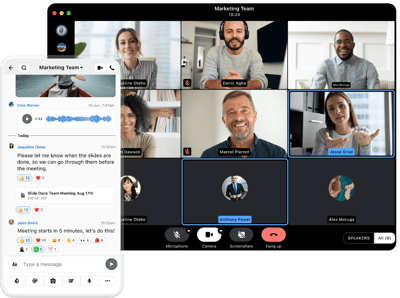
In many enterprises, communication is fragmented across multiple tools. Employees move between email, Microsoft Teams or Slack, WhatsApp groups, video conferencing platforms, file-sharing applications, and in some cases even legacy phone systems just to complete everyday work. Usually, because no single tool provides secure communication across multiple formats.
For security and compliance teams, this creates a difficult challenge:
- Determining who can access sensitive information across multiple platforms
- Understanding where communication data is stored and processed
- Verifying that communications are adequately protected
- Ensuring your teammates and employees are meeting regulatory and compliance requirements
In this article, we’ll explore how enterprise communication solutions help with these issues, the main types available, how to evaluate them, and why platforms built around security, compliance, and operational resilience, such as Wire, stand apart from traditional communication tools.
But before we start, see how Wire unifies enterprise communication without compromising security → Book a Demo
Key takeaways
-
Most organizations use multiple communication tools at the same time for messaging, meetings, file sharing, and external collaboration, which creates security gaps, governance challenges, and unnecessary complexity.
-
Security teams, IT leaders, and compliance officers need visibility into how information is shared, who can access it, where data is stored, and whether communications meet regulatory requirements.
-
When evaluating enterprise communication solutions, consider security architecture, deployment flexibility, identity management, compliance support, secure external collaboration, and resilience during incidents.
-
Wire brings messaging, calling, conferencing, file sharing, external collaboration, and crisis communication together in a single platform with end-to-end encryption by default, helping organizations reduce tool sprawl without compromising security.
What are enterprise communication solutions?
Enterprise communication solutions are platforms and technologies that enable organizations to communicate and collaborate (internally & externally) at scale. They typically combine messaging, voice and video calling, file sharing, and conferencing, enabling collaboration while providing the administrative controls, security, compliance, and scalability that businesses require.
The category includes a range of communication tools:
- Team messaging platforms such as Slack, Teams, and Wire
- Video conferencing platforms such as Zoom, Google Meet, and Wire
- File sharing and collaboration infrastructure such as SharePoint, Google Drive, and Wire Drive
- Unified communications platforms that combine several of these under a single architecture.
For a long time, most organizations evaluated communication tools based solely on feature sets, integrations, and per-seat pricing. But now, they also consider admin controls, compliance readiness, identity management, and security governance as core, along with ease of use.
Before we compare tools you can consider, let’s understand the different types of enterprise communication tools.
The 5 types of enterprise communication solutions
There are 5 main types of enterprise communication solutions: team messaging, voice and video conferencing, file sharing and document collaboration, external collaboration, and crisis communication.
While these categories often overlap, each serves a distinct purpose in helping organizations communicate securely and efficiently. Understanding them can help you identify the current gaps, reduce tool sprawl, and build a more cohesive enterprise communication strategy.
Wire is one of the few platforms that offers all five of these, with end-to-end encryption (E2EE) applied consistently across each.
Team messaging & persistent chat
Team messaging platforms offer an easy day-to-day communication for your team.
They allow your team to send direct messages, create channels for departments or projects, share updates, and maintain searchable conversation histories.
Messaging has become one of the main internal communication solutions for enterprises, but the challenge is ensuring these conversations remain secure and governed.
MS Teams and Slack are popular examples of this, but they don’t offer E2EE by default across chat. Learn more about Microsoft E2EE limitations.
Organizations therefore need tools that are easy for employees to use while still providing controls such as identity management, retention policies, and end-to-end encryption.
Wire extends this model by protecting all messages with E2EE by default while ensuring that even administrators can’t access your message content.
Voice & video conferencing
Enterprise voice and video covers everything from 1:1 calls to large-scale group conferencing and webinars. However, many conferencing platforms don’t provide E2EE by default for video, meaning service providers may get access to call content.
This is usually because securing large-group calls is quite complex, especially when collaboration features such as in-meeting chat, reactions, hand-raising, and screen sharing must also remain end-to-end encrypted.
Wire's Conferencing Hub delivers E2EE audio and video for up to hundreds of participants using the Messaging Layer Security (MLS) protocol that enables secure communication at scale.
To learn more about how encrypted conferencing works and why it’s important for enterprise security, explore Wire's guide to encrypted video conferencing.
File sharing & document collaboration
Teams need a secure way to exchange files, collaborate on documents, and manage information across projects and departments.
But traditional file-sharing tools often operate separately from communication platforms, forcing employees to switch between multiple applications. Many businesses now prefer secure collaboration solutions that let teams share, review, and work on documents without leaving the tools they already use to communicate.
Wire Drive brings secure file sharing and document collaboration into the same environment as messaging and meetings, while Pydio Cells provides the underlying enterprise content management (ECM) capabilities that support governance, access control, and collaboration.
External collaboration
Business communication often extends far beyond internal teams because teams regularly collaborate with external suppliers, contractors, customers, legal counsel, regulators, and partners.
Secure external collaboration tools make it possible to communicate across organizational boundaries without sacrificing security.
Features such as guest access, secure sharing links, and federated communication allow organizations to collaborate while maintaining oversight of sensitive information.
Wire supports secure federation between independently managed environments and provides password-protected guest access for controlled external collaboration.
Crisis & out-of-band communication
When primary communication infrastructure is compromised, whether by ransomware, a network outage, or a targeted attack, your team needs a communication channel that operates independently to coordinate response efforts and communicate securely.
Wire is designed to provide a fallback out-of-band communication channel, separate from the systems that may be under attack, compromised, or otherwise unavailable during an incident. This separation helps organizations maintain secure coordination between response teams, executives, and key stakeholders when primary communication tools can’t be trusted or accessed.
Wire also supports real-time E2EE encrypted location sharing, providing an additional layer of situational awareness for teams operating in the field.
While these 5 categories cover the core functions organizations need, many enterprise communication platforms only address one or two areas. As businesses add separate tools for messaging, meetings, file sharing, external collaboration, and crisis response, they often create fragmented user experiences, security gaps, and increased administrative complexity. Read on to know more.
Why traditional enterprise communication platforms fall short
Traditional enterprise communication platforms often prioritize productivity over security, compliance, and data sovereignty. As organizations face stricter regulations and handle more sensitive information, these design limitations can create governance, visibility, and protection challenges.
Shadow IT continues to expand
One of the most persistent communication challenges is shadow IT communication in enterprises. When approved enterprise communication tools are slow, difficult to use, or unavailable in certain situations, employees often turn to consumer applications such as WhatsApp, Telegram, or personal Signal accounts. These tools may feel convenient, but they create significant governance problems because business conversations take place outside approved systems. And most of these tools, like WhatsApp, aren’t truly end-to-end encrypted.
Encryption claims vs. encryption reality
Most enterprise communication tools encrypt data in transit using Transport Layer Security (TLS), which protects information as it travels between devices and servers, and encrypt data at rest using AES-256 (Advanced Encryption Standard with 256-bit keys), which secures stored data against unauthorized access.
These measures prevent unauthorized access from external attackers. However, they don’t necessarily prevent the service provider, privileged administrators, or anyone with access to encryption keys from viewing communication content.
True E2EE means only the participants in a conversation hold the keys to decrypt it.
For example, Microsoft Teams offers E2EE only for specific use, such as 1:1 calls, and it must be enabled separately. Similarly, Slack secures data in transit and at rest but does not provide E2EE for messages, meaning message content remains accessible within the platform's service architecture.
For organizations handling confidential discussions, intellectual property, customer data, or operational information, this distinction is increasingly important.
True E2EE that’s enabled by default across communication channels ensures that only participants in a conversation can access its contents, yet many enterprise platforms either limit this protection to specific use cases or require it to be enabled manually.
Policy-based security vs. architectural security
Traditional enterprise platforms such as Slack and Microsoft Teams enforce security through administrative policies, roles, permissions, and configuration settings.
These controls provide important governance capabilities, but they depend on administrators configuring and maintaining them correctly over time. A single misconfiguration, compromised administrator account, or overlooked setting can create unnecessary risk.
Wire takes a different approach by enforcing security at the protocol level. Wire applies E2EE by default and uses Operator Shield to ensure that even Wire administrators can’t access message content.
Even if an administrator account is compromised, the attacker can’t read encrypted conversations. This architecture reduces reliance on administrative controls as the primary line of defense.
Compliance gaps
Organizations operating in regulated industries like finance or healthcare must comply with frameworks that govern how sensitive information is protected and managed. These include:
Auditors and regulators in companies also want information on how communication systems are designed, how encryption is implemented, where data is stored, and who can access it to make the right choice. But most traditional enterprise messaging and collaboration platforms don’t provide it.
Fragmented tools
As we mentioned above, there are multiple types of communication tools, and companies use different tools for different tasks. They may use one platform for messaging, another for meetings, email for document sharing, and consumer applications for urgent conversations.
Each additional tool introduces separate access controls, data policies, user management requirements, and security considerations. Over time, this fragmentation increases operational complexity and expands the organization's attack surface.
It also creates a poor user experience. When communication is spread across multiple systems, employees spend more time switching between applications or figuring out where the important document went and less time collaborating effectively.
This is why many organizations are reassessing their communication solutions as a whole rather than evaluating tools individually to improve their enterprise communication strategy. The goal is no longer simply to provide secure messaging, meetings, or file sharing. It is to create a unified communication environment that is secure, manageable, compliant, and easy for employees to adopt.
See how Wire helps with that.
What to look for in an enterprise communication solution
When evaluating an enterprise communication solution, organizations should look beyond messaging and meeting features and focus on security, compliance, deployment flexibility, identity management, crisis resilience, and ease of adoption.
The right platform should protect sensitive communications while supporting operational and regulatory requirements because security leaders, IT teams, and compliance officers increasingly evaluate enterprise communication tools based on how they protect data, support governance, and reduce risk across the organization.
Here are a few specific things to look for.
End-to-end encryption by default
Many platforms offer E2EE only for specific use cases or require administrators and users to enable it manually. This creates unnecessary risk because protection depends on configuration choices that may not always be applied consistently.
When evaluating vendors, ask:
- Is end-to-end encryption enabled by default?
- Does it cover messaging, voice calls, video meetings, and file sharing across multiple users?
- Can administrators or service providers access communication content?
Security-first communication platforms enforce encryption at the architecture level so that communication remains protected regardless of user behavior or administrative settings.
For instance, Wire applies E2EE by default across messaging, calling, conferencing, and file sharing, while ensuring that even Wire administrators can’t access message content.
Sovereign deployment options
Different organizations have different requirements for data residency, infrastructure control, and regulatory compliance.
Some businesses may prefer cloud-based deployments. But government agencies, critical infrastructure operators, defense organizations, and regulated enterprises often require private cloud, on-premises, or air-gapped deployments that provide greater control over where communication data is stored and processed.
Wire supports public cloud, private cloud, on-premises, and fully air-gapped deployments, allowing organizations to match their deployment model to their data classification requirements while continuing to use the same platform.
This flexibility helps organizations align their communication infrastructure with their security and compliance obligations rather than adapting those requirements to a vendor's infrastructure model.
Learn more about Wire’s deployment options here.
Enterprise identity & access management
In every company, employees regularly join teams, change roles, switch devices, or even leave. Without centralized identity controls, managing access in these changing circumstances can become quite tricky.
But the right secure enterprise communication tool manages it effectively through features like:
- Single Sign-On (SSO)
- System for Cross-domain Identity Management (SCIM)-based user provisioning and deprovisioning
- Role-based access controls
- Device verification and trust management
Wire's ID Shield handles this by automatically verifying trusted devices through the organization's existing Identity Provider and managing device authorization without requiring manual intervention.
Guest access & secure federation
Employees regularly collaborate with external suppliers, contractors, legal advisors, government agencies, customers, and strategic partners. The challenge is enabling these interactions without creating security gaps or exposing internal systems.
When evaluating a platform, consider:
- How external users are invited and managed
- Whether guest access can be controlled securely
- Whether organizations can communicate across independently managed environments
- How access is revoked when collaboration ends
Platforms that support secure federation and controlled guest access make it easier to collaborate externally while maintaining governance and administrative oversight.
For example, Wire offers secure federation between independently managed Wire instances, allowing separate organizations to communicate and collaborate securely while each retains full administrative control over its own users, policies, and data. This makes it possible to work with external teams without giving up security or control.
Compliance & auditability
With growing compliance requirements, organizations need communication platforms that support regulatory obligations and provide clear evidence of appropriate protection of sensitive information.
Some questions to consider here:
- Does the platform support the compliance frameworks relevant to your sector? Is it a NIS2-compliant communication platform? Or, does it provide other compliance, like GDPR, DORA, HIPAA, ISO 27001, or FedRAMP?
- Are audit logs available for administrative actions?
- Can the organization demonstrate how communication data is protected?
- Does the platform support your organization's data residency and retention requirements?
When evaluating vendors, look for independently validated certifications and compliance credentials.
Wire holds ISO 27001 and ISO 27701, along with Cyber Essentials, the UK government-backed baseline certification. Our platform also helps with DORA, NIS2, and is GDPR compliant.
Resilience & out-of-band capability
Organizations often focus on functionality, security, and compliance when evaluating a platform but overlook how it performs during a crisis.
When primary systems are disrupted, compromised, or unavailable, teams still need a trusted way to coordinate and share information securely. Evaluating a platform's ability to support communication during these scenarios is an important part of assessing operational resilience.
Wire helps here as it's designed to function as an out-of-band communication channel, independent from the primary IT infrastructure that may be under attack or unavailable.
But beyond immediate crisis communication, Wire's architecture also supports post-incident recovery. It helps you quarantine compromised accounts, maintain trusted communication channels during remediation efforts, and restore normal operations while benefiting from MLS-based post-compromise protection.
Ease of use
There is a reason why consumer communication apps remain so popular in the workplace, even when they fall short of enterprise security requirements. Employees naturally choose tools that are fast, intuitive, and easy to use.
When secure communication platforms introduce friction through complex interfaces, lengthy authentication steps, or inconsistent user experiences, users often look for simpler alternatives.
This creates a common challenge for organizations: the more difficult a platform is to use, the more likely employees are to bypass it altogether simply because teams need a way to communicate quickly. The tool you choose should balance security with an intuitive user experience so it’s easy for employees to adopt and use every day.
Wire is designed with this balance in mind, combining enterprise-grade security with a user experience that’s easy to adopt.
Enterprise communication solutions comparison
Keeping the features we discussed above in mind, here’s a comparison of some of the most popular enterprise communication tools to help you choose the right one.
| Evaluation criterion |
Wire |
MS Teams |
Slack |
Signal |
| E2EE by default (all features) |
✓ |
⚠ Opt-in 1:1 only |
✗ |
⚠ Consumer only |
| MLS protocol |
✓ |
✗ |
✗ |
✗ |
| Zero trust architecture |
✓ |
⚠ Partial |
✗ |
✗ |
| Local encryption key storage |
✓ |
✗ |
✗ |
✓ |
| On-prem / sovereign deployment |
✓ |
⚠ Limited |
✗ |
✗ |
| Secure federation |
✓ |
⚠ Limited |
✗ |
✗ |
| SSO + SCIM provisioning |
✓ |
✓ |
✓ |
✗ |
| E2EE file sharing |
✓ |
✗ |
✗ |
⚠ Limited |
| E2EE group conferencing |
✓ |
✗ |
✗ |
⚠ Up to 75 |
| Open source / auditable |
✓ |
✗ |
✗ |
✓ |
| Approved for classified comms by the German government |
Wire Bund |
✗ |
✗ |
✗ |
| Enterprise governance and auditability |
✓ |
✓ |
⚠ Partial |
✗ |
✓ Supported by default ⚠ Limited or opt-in ✗ Not supported
A few things that stand out among these tools that can help you choose:
- E2EE is not implemented equally across platforms: MS Teams offers E2EE only for 1:1 communications, and even then it has to be implemented manually. Slack doesn’t offer E2EE, while Signal's E2EE is consumer-grade. For organizations handling sensitive information, encryption that is enabled by default across messaging, meetings, and file sharing reduces the risk of accidental exposure and configuration errors.
- Enterprise governance matters as much as security: Consumer applications such as Signal provide local encryption key storage but lack capabilities such as SSO, SCIM provisioning, audit controls, compliance reporting, and centralized administration. For regulated organizations, these controls are often just as important as encryption itself.
- Deployment flexibility affects sovereignty and compliance: Organizations in government, defense, healthcare, financial services, and critical infrastructure often need greater control over where communication data is stored and processed. Support for private cloud, on-premises, and air-gapped deployments can be a key requirement here, which is limited or not available in Slack, MS Teams, and Signal.
- Secure external collaboration: Most organizations need to communicate with suppliers, contractors, customers, regulators, and partners. Platforms that support secure federation and controlled external collaboration make it easier to collaborate externally without sacrificing security or governance.
For a detailed comparison, check out:
Or, see how Wire can help your team communicate securely. Get in touch.
Enterprise communication solutions by industry
Every organization evaluates enterprise communication solutions in different ways. For example, a retail company coordinating frontline workers has different priorities than a government agency handling classified information.
While messaging, calling, conferencing, and file sharing are common requirements across industries, the security, compliance, deployment, and governance needs surrounding those capabilities can vary significantly.
Understanding these differences can help you identify which enterprise communication software is best suited to your specific industry.
Government & public sector
Government agencies handle sensitive information, coordinate across departments, and often collaborate with external agencies and partners. Communication platforms in this sector must support strict security requirements, data sovereignty, and regulatory compliance.
Key priorities often include:
- End-to-end encryption by default
- Sovereign deployment options
- Secure federation between agencies
- Support for classified or sensitive communications
- Long-term compliance and auditability
Wire Bund is approved by Germany's Federal Office for Information Security (BSI) for VS-NfD communications, a classification level comparable to NATO Confidential.
It is currently the only collaboration platform with this approval and is trusted by ministries, intelligence agencies, law enforcement organizations, and defense institutions across Europe.
Learn more about Wire’s government use case.
Financial services
Banks, insurers, investment firms, and financial institutions operate under extensive regulatory oversight. Communication platforms must protect sensitive financial data while supporting internal collaboration and secure external client interactions.
- End-to-end encryption across messaging, calls, meetings, and file sharing
- Compliance with frameworks such as DORA, GDPR, and MiFID II
- Detailed audit trails
- Identity and access management controls
- Secure document sharing and collaboration
Wire's zero-knowledge architecture ensures that no third party (including Wire itself) can access communications, helping organizations meet strict confidentiality and data protection requirements.
For sharing sensitive financial documents, Wire Drive provides E2EE file sharing directly within the collaboration environment, eliminating the need for separate file transfer tools while maintaining security and control.
Healthcare
For sharing sensitive financial documents, Wire Drive provides E2EE file sharing directly within the collaboration environment, eliminating the need for separate file transfer tools while maintaining security and control.
Healthcare
Healthcare providers, hospitals, and medical organizations regularly exchange highly sensitive patient information. Protecting confidentiality while enabling fast communication between care teams is essential to provide quality care.
Key priorities for a communication tool in this industry often include:
- Protection of patient and medical data
- Compliance with HIPAA and EU health data regulations
- Secure mobile communication for clinical and administrative staff
- Controlled file and document sharing
- Reliable communication during emergencies
- Strong safeguards for protected health information (PHI)
Platforms like Wire provide E2EE by default and offer on-premises deployment options that help organizations address data residency requirements and PHI.
Critical infrastructure & energy
Organizations operating critical infrastructure, utilities, transportation networks, and energy systems need secure communication tools for both daily operations and incident response.
These environments often involve distributed field teams, Operational Technology (OT) systems, contractors, regulators, and emergency responders. During outages, cyberattacks, or infrastructure disruptions, teams need a reliable way to coordinate even when primary communication systems are unavailable or compromised.
Wire provides a resilient, separate communication layer for crisis response, allowing teams to continue coordinating securely when compromised accounts can’t be used or trusted. Users can stay signed in on up to 8 trusted devices, including desktop, mobile, tablet, and web browser sessions, making it easier to maintain communication continuity when access to a primary device or system is disrupted.
Wire also supports real-time end-to-end encrypted location sharing, helping field teams coordinate emergency repairs, site inspections, and response efforts while protecting sensitive operational movements.
Defense & intelligence
Defense and intelligence organizations operate in environments where communication security extends beyond message content. They also need to protect metadata, verify devices, control deployment environments, and maintain resilience in hostile or highly sensitive operating conditions.
Wire's Metadata Mask helps obscure communication patterns so Wire activity appears as ordinary web traffic. This is particularly relevant for intelligence, law enforcement, and field operations where exposing communication activity can create risk, even when message content remains encrypted.
Wire's ID Shield also strengthens device trust by verifying devices through the organization's existing Identity Provider. This allows teams to certify, renew, or revoke trusted devices, helping ensure that only authenticated devices can communicate on the platform.
Why enterprises choose Wire as their enterprise communication platform
Wire brings together secure messaging, voice and video conferencing, file collaboration, identity management, sovereign deployment options, and crisis communication capabilities in a single enterprise communication software.
This allows you to reduce tool sprawl, simplify governance, and protect sensitive communications without forcing users to choose between security and usability.
Here are a few of the many reasons companies choose Wire as their primary communication software:
- One unified platform: Wire combines messaging, voice calls, video conferencing, external collaboration, and file sharing. Every communication channel is protected with E2EE by default, eliminating the security gaps that can emerge when organizations rely on separate tools.
- Always-on E2EE: Wire is built on the MLS protocol and was the first secure enterprise communication platform to implement MLS at scale. Our platform enables E2EE at the protocol level across all communication methods, ensuring that only intended participants have access.
- Zero trust, zero knowledge security architecture: Wire follows a Zero Trust and Zero Knowledge security model where users, devices, and communications are continuously authenticated and protected. The Operator Shield ensures that even Wire administrators can’t access message content, reducing reliance on administrative controls and protecting communications from unauthorized access.
- Built for regulated environments: Supports compliance requirements through certifications including ISO 27001 and ISO 27701, along with Cyber Essentials, which is the UK government-backed baseline certification. The software helps with DORA, NIS2, and is GDPR compliant. For government organizations, Wire Bund is approved by Germany's Federal Office for Information Security (BSI) for VS-NfD classified communications.
- Open source and auditable: Wire makes its cryptographic protocols and security components available for independent review. This transparency allows organizations and security researchers to verify how communications are protected rather than relying solely on vendor assurances.
Wire is trusted by more than 1,800 organizations worldwide, including government agencies, defense organizations, critical infrastructure operators, and enterprises such as ExxonMobil, NASA, the U.S. Air Force, EY, and Schwarz Group.
Beyond its security credentials, Wire is designed for everyday usability, helping organizations reduce shadow IT and drive adoption without sacrificing productivity.
This combination of enterprise-grade protection and a user-friendly experience is what gives Wire a 95% customer retention rate, showing that you do not have to choose between strong security and effective collaboration.
Book a demo to see Wire in action and explore the deployment options, security controls, and collaboration features that fit your organization's needs.
Frequently asked questions